

AI Basics
Beginner
8 min read
What is AI?
Understand Artificial Intelligence as the broad field of building systems that perform tasks requiring human-like intelligence.
Introduction
Artificial Intelligence, or AI, is the ability of a computer system to perform tasks that usually require human intelligence. These tasks may include understanding language, recognizing images, making decisions, solving problems, giving recommendations, or creating new content such as text, images, music, or code.
AI is not a single tool. It is a broad field of computer science that includes many methods and technologies. Some AI systems are simple and rule-based, while others are more advanced and can learn from large amounts of data.
AI is best understood as a family of technologies that help machines perform tasks that seem intelligent.
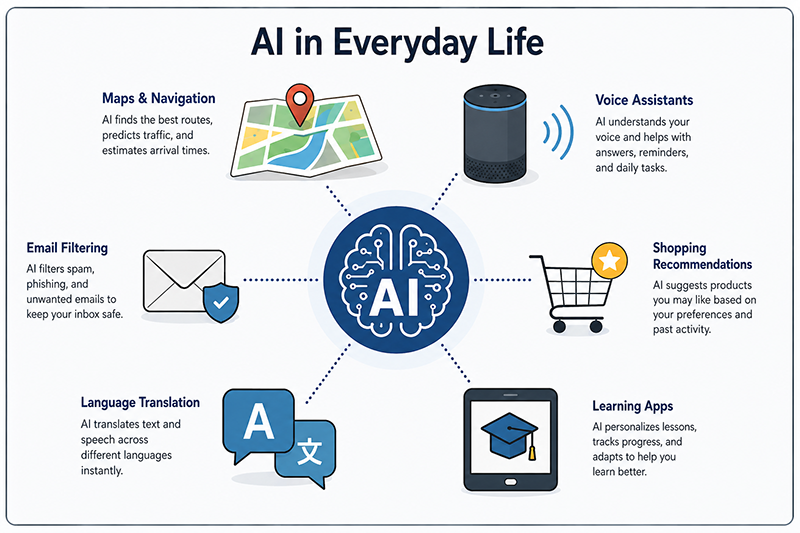
You may already use AI every day without realizing it. When your phone suggests the next word while typing, when a video platform recommends what to watch, when a navigation app predicts traffic, or when an email service filters spam, AI is quietly working in the background to make these experiences more useful and personalized.
Understanding AI begins with seeing it as the big picture. Many of the technologies people associate with AI today, such as chatbots, image generators, and recommendation systems, are actually different branches of AI. In the next article, Machine Learning, you will discover one of the most important techniques that makes modern AI possible.
Understanding Artificial Intelligence
AI can be divided into different levels. Narrow AI, also called Weak AI, is designed to perform specific tasks. Most AI we use today is narrow AI.
General AI, sometimes called Artificial General Intelligence, or AGI, refers to a machine that could understand, learn, and apply knowledge across many different situations just like a human. Although researchers continue to study AGI, it does not yet exist.
AI is not magic. It does not possess consciousness, emotions, or common sense. Instead, it identifies patterns, follows mathematical models, and produces outputs based on the information it has been given during development or training.
Most modern AI systems are powered by Machine Learning, which allows computers to learn patterns from data instead of following only hand-written rules.
AI Around Us
The best way to appreciate AI is to look at how often it appears in daily life. Even if you have never intentionally used an AI application, chances are you interact with AI many times each day.
Navigation apps predict traffic conditions and suggest faster routes. Streaming platforms recommend movies and music. Shopping websites suggest products. Email services detect spam. Banks use AI to identify unusual transactions. Hospitals use AI to help doctors analyze medical images.
Despite these impressive capabilities, AI also has important limitations. AI systems depend heavily on the quality of the data used to build them. If that data is incomplete, inaccurate, or biased, the system's predictions may also be inaccurate or unfair.
AI can support human work, but it should not replace careful human thinking, responsibility, and ethical decision-making.
Conclusion
Artificial Intelligence is one of the most important technologies of the twenty-first century. It is already transforming the way we communicate, work, learn, travel, shop, and solve problems.
Throughout this AI Basics learning path, you will gradually uncover the building blocks behind modern AI. In the next article, you will explore Machine Learning. Later, you will discover how Deep Learning extends these ideas, how Neural Networks provide the underlying structure, and how Large Language Models power conversational AI systems.
Key Takeaways
- Artificial Intelligence is the broad field of creating computer systems that can perform tasks requiring human-like intelligence.
- AI is already used in everyday applications such as navigation, recommendations, translation, spam filtering, and voice assistants.
- Most AI today is Narrow AI, designed for specific tasks rather than general human intelligence.
- AI systems do not think or feel like humans; they recognize patterns and make predictions based on data.
- The quality of an AI system depends heavily on the quality of the data used to build and train it.
- Machine Learning is one of the most important technologies behind modern AI.