

The Science of AI
Beginner
8 min read
Scaling Laws & Emergence
Discover how increasing the size, data, and computing power of AI models can unlock surprising new capabilities — and why scaling has become one of the biggest drivers of modern AI.
Introduction
Over the past few years, Artificial Intelligence has improved at an astonishing pace. Modern AI systems can write software, summarize research papers, generate realistic images, answer complex questions, translate languages, and assist with countless professional tasks. One of the most surprising discoveries behind these advances is that many improvements did not come from programming entirely new abilities into AI. Instead, researchers found that simply making models larger and training them on more data often produced capabilities that were not present before.This observation led to one of the most influential ideas in modern AI research: scaling laws. These mathematical relationships describe how AI performance changes as researchers increase model size, training data, and computing power. Closely related to this is the concept of emergence, where new behaviors appear once a model reaches a sufficient scale.
Together, scaling laws and emergence help explain why today's AI systems are dramatically more capable than earlier generations—and why the future of AI is shaped not only by better algorithms but also by the scale at which those algorithms operate.
What Are Scaling Laws?
Imagine teaching two students.The first student studies from a single textbook for one week. The second studies from hundreds of books over several years while receiving expert guidance. Although both students learn using the same fundamental learning process, the second is likely to develop much broader knowledge and stronger reasoning abilities.
Modern AI models behave in a surprisingly similar way.
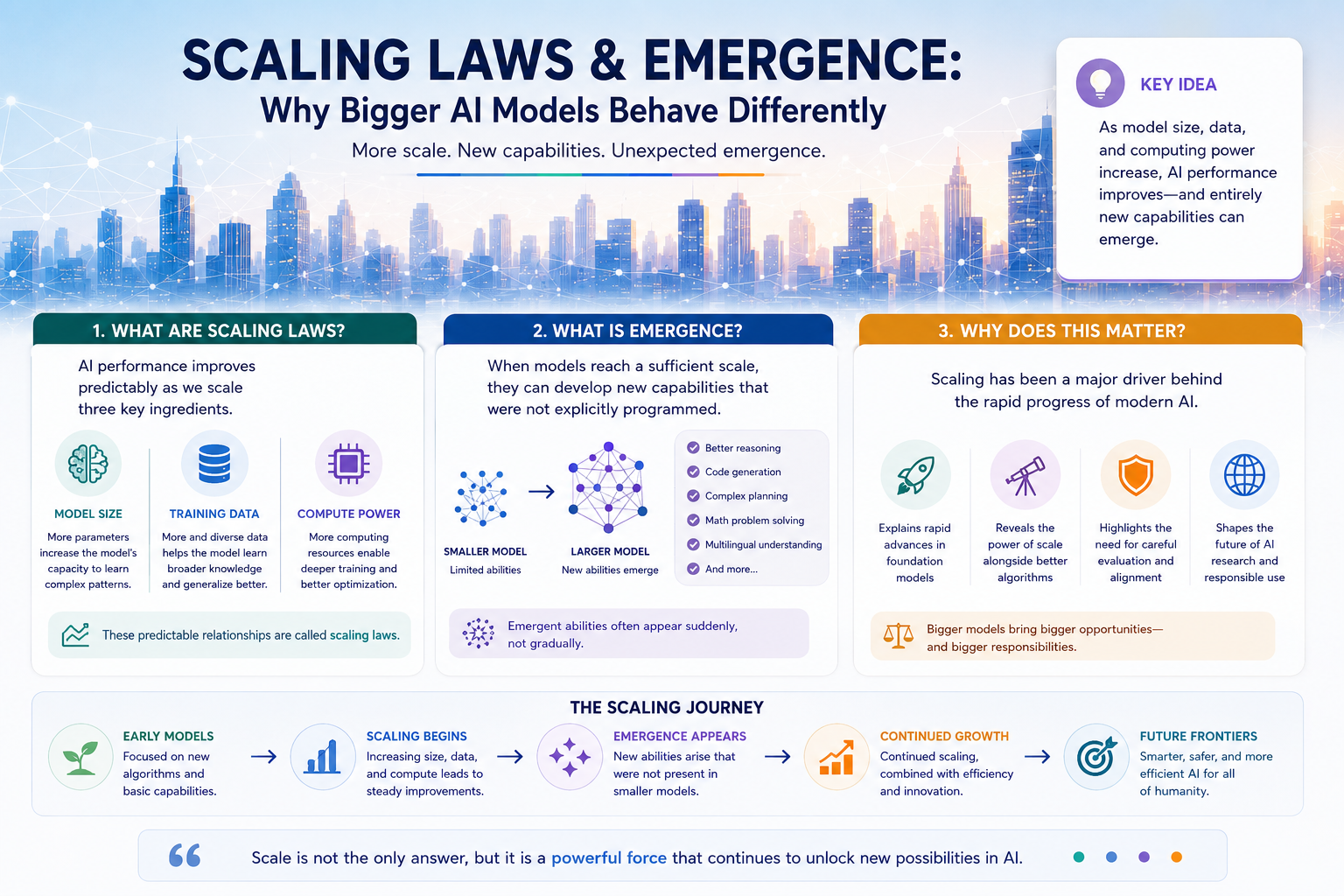
Researchers have found that increasing three key ingredients often improves AI performance:
- Model size (the number of parameters)
- Training data (the amount and diversity of information used for learning)
- Computing power (the resources available for training)
Rather than reaching an early limit, many AI models continue improving as they become larger and are trained on richer datasets using more computational resources.
Why Bigger Models Behave Differently
At first glance, it might seem reasonable to assume that a model twice as large would simply perform twice as well.However, AI researchers observed something far more interesting.
As models became sufficiently large, they sometimes demonstrated abilities that smaller versions could not perform at all.
For example, a smaller language model might struggle with complex reasoning or long-form planning, while a much larger version suddenly performs these tasks with surprising competence.
These improvements are not merely gradual increases in accuracy. Instead, they often appear as qualitative changes, where the model begins solving entirely new categories of problems.
This observation led researchers to describe these unexpected capabilities as emergent behaviors.
What Is Emergence?
Emergence refers to the appearance of new capabilities that were not explicitly programmed into an AI system and were not clearly visible in smaller versions of the same model.A useful analogy comes from nature.
A single water molecule does not create a wave. However, millions of water molecules interacting together can produce complex patterns such as tides, currents, and waves that cannot be understood simply by examining one molecule in isolation.
Similarly, individual artificial neurons are relatively simple. Yet when billions of them interact within a sufficiently large neural network, entirely new behaviors may appear.
Examples of emergent capabilities discussed by researchers include:
- More reliable multi-step reasoning
- Better understanding of complex instructions
- Stronger programming abilities
- Improved mathematical problem-solving
- Better multilingual performance
- More effective transfer of knowledge between tasks Importantly, researchers continue to study why some capabilities emerge suddenly while others improve gradually. The phenomenon remains one of the most active areas of AI research.
Scaling Has Limits
Although scaling has driven remarkable progress, it is not a limitless solution.Building larger AI models requires enormous computational resources, significant energy consumption, specialized hardware, and increasingly large datasets. These practical constraints mean that indefinitely increasing model size becomes progressively more expensive.
Researchers therefore continue exploring complementary approaches that improve efficiency as well as capability. These include better model architectures, improved training methods, model distillation, retrieval techniques, and more efficient reasoning strategies.
Future AI progress is therefore likely to combine continued scaling with innovations that allow models to become both more capable and more efficient.
Why Scaling Laws Matter
Understanding scaling laws helps explain many developments that have shaped modern AI over the past decade.It clarifies why today's AI models differ so dramatically from earlier systems despite using many of the same underlying principles. It also helps explain why researchers continue investing in larger datasets, more efficient hardware, and improved training techniques.
At the same time, emergence reminds us that increasingly capable AI systems may display behaviors that are difficult to predict from smaller experimental models alone.
This uncertainty makes careful evaluation, interpretability, alignment research, and responsible governance increasingly important as AI systems continue to grow.
Conclusion
Scaling laws and emergence have fundamentally changed our understanding of how modern AI develops increasingly sophisticated capabilities. Rather than relying solely on entirely new algorithms, much of recent AI progress has come from expanding existing models through larger datasets, greater computational resources, and increased model capacity.Yet scaling is only part of the story. Researchers continue exploring why new capabilities emerge, where the limits of scaling may lie, and how increasingly powerful AI systems can remain efficient, interpretable, and aligned with human values.
Understanding these ideas provides valuable insight into why today's AI systems behave differently from their predecessors and why future advances may continue to surprise both researchers and society.
In the next article, Generalization & the Loss Landscape: How AI Learns Beyond Memorization, we will explore another fundamental question: How does AI learn patterns that extend beyond the examples it has already seen?
Key Takeaways
- Scaling laws describe how AI performance improves as model size, training data, and computing resources increase.
- Modern AI has advanced significantly because researchers discovered predictable relationships between scale and capability.
- Emergence refers to new abilities that appear in sufficiently large AI models without being explicitly programmed.
- Larger models often demonstrate qualitative improvements, such as stronger reasoning, programming, and language understanding.
- Scaling alone is not unlimited and must be balanced with efficiency, sustainability, and responsible development.
- Understanding scaling laws helps explain the rapid progress of today's foundation models and large language models.
- Scaling and emergence remain active areas of AI research, offering valuable insight into how future AI systems may continue to evolve.