

Prompt Engineering
Intermediate
10 min read
Chain of Thought Prompting
Guide AI through structured reasoning to solve complex problems with greater clarity, accuracy, and confidence.
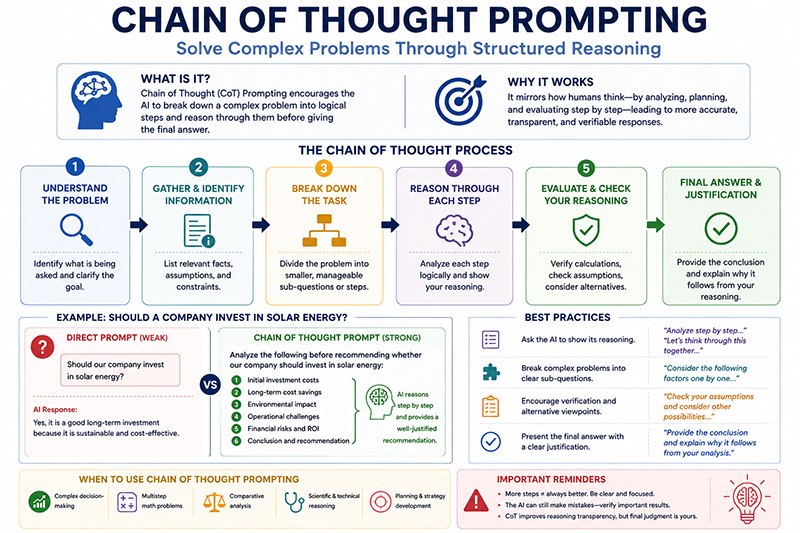
Introduction
Many real-world problems cannot be solved in a single step. A doctor diagnosing a patient, an engineer designing a bridge, or a financial analyst evaluating an investment all work through a sequence of logical decisions before arriving at a conclusion. They gather information, analyze evidence, consider alternatives, and justify their recommendations.
Modern Artificial Intelligence systems can often benefit from a similar approach.
Chain of Thought Prompting is a prompt engineering technique that encourages an AI model to solve a complex problem through a sequence of logical reasoning steps rather than producing an immediate answer. By breaking a problem into smaller components, the model often produces responses that are more accurate, transparent, and easier to verify.
Rather than asking only for the final result, the prompt guides the AI to explain its reasoning, evaluate intermediate steps, or organize its thinking before presenting a conclusion.
The second prompt encourages structured analysis rather than a simple opinion.
Chain of Thought Prompting builds upon every technique introduced so far. The CLEAR Framework provides the structure of the prompt, Role Prompting defines the perspective, and Few-shot Prompting can demonstrate examples of good reasoning. Chain of Thought Prompting then guides the AI through the reasoning process itself.
Although this technique is especially valuable for analytical tasks, it is equally useful in education, business, healthcare, engineering, finance, and scientific research whenever careful reasoning is required.
How Chain of Thought Prompting Works
Large Language Models are exceptionally good at identifying relationships between ideas. However, many complex tasks involve multiple intermediate decisions rather than a single prediction.
Chain of Thought Prompting encourages the model to organize those intermediate decisions into a logical sequence.
Instead of asking for only an answer, the prompt may request that the AI:
- Identify the problem.
- Gather relevant information.
- Evaluate alternative solutions.
- Explain assumptions.
- Justify conclusions.
- Summarize recommendations.
This structured approach often produces responses that are easier to understand and verify.
Simple Example
The AI may recommend a model immediately, but the reasoning behind the recommendation may be unclear.
Now the recommendation becomes easier to evaluate because each step contributes to the final conclusion.
Importantly, Chain of Thought Prompting does not guarantee that the AI's reasoning is always correct. Like humans, AI systems can still make mistakes in logic or rely on incorrect information. However, organizing the reasoning process makes these mistakes easier to identify and correct.
Modern reasoning-focused AI models—including those discussed earlier such as ChatGPT, Claude, Gemini, and DeepSeek—have become increasingly capable of performing sophisticated multi-step analysis. Prompting techniques that encourage structured reasoning therefore remain valuable even as model capabilities continue to improve.
Examples from Different Professions
Example 1 — Research Scientist
Why It Is Better: Instead of producing a simple opinion, the AI evaluates each component of the research process before reaching a conclusion, making the assessment more transparent and academically rigorous.
Example 2 — Software Engineer
Why It Is Better: The AI follows a systematic debugging process similar to an experienced software engineer rather than immediately guessing the cause of the problem.
Example 3 — Healthcare Professional
Why It Is Better: The AI evaluates multiple possibilities instead of immediately selecting a diagnosis, demonstrating the structured clinical reasoning expected in healthcare.
Example 4 — Financial Analyst
Why It Is Better: The AI considers multiple financial indicators before making a recommendation, closely reflecting the analytical process used by professional investment analysts.
Example 5 — Civil Engineer
Why It Is Better: Rather than selecting an option immediately, the AI evaluates multiple engineering criteria before justifying its final recommendation.
Usefulness
Chain of Thought Prompting is particularly valuable whenever accuracy depends on careful reasoning rather than simple information retrieval.
In education, it helps students understand how solutions are developed rather than simply memorizing answers.
In scientific research, it encourages systematic evaluation of evidence and competing explanations.
In software engineering, it supports debugging, system design, and architectural decision-making.
In finance, it promotes structured investment analysis and risk assessment.
In healthcare, it mirrors the logical reasoning process used during clinical decision-making and patient assessment.
Another important advantage is transparency. When AI explains the reasoning behind its recommendations, users can more easily identify assumptions, verify conclusions, and challenge incorrect reasoning when necessary.
Chain of Thought Prompting also combines naturally with earlier techniques. A prompt may first establish the task using the CLEAR Framework, assign an expert perspective through Role Prompting, demonstrate preferred reasoning using Few-shot Prompting, and finally request a structured analytical process through Chain of Thought Prompting.
Limitations
Despite its advantages, Chain of Thought Prompting is not appropriate for every task.
Simple requests—such as writing a short email or generating a product description—usually do not require extensive reasoning. Asking for unnecessary intermediate steps may simply increase response length without improving quality.
Additionally, structured reasoning does not guarantee correctness. AI systems may still base their analysis on incomplete information, incorrect assumptions, or outdated knowledge.
Users should also avoid assuming that longer reasoning automatically means better reasoning. Clear, logical analysis is generally more valuable than unnecessarily lengthy explanations.
Finally, as AI systems continue to evolve, many frontier models perform sophisticated internal reasoning automatically. In such cases, users should focus on requesting well-structured explanations rather than expecting every internal reasoning step to be exposed.
Conclusion
Chain of Thought Prompting helps transform AI from a system that simply generates answers into one that supports structured analytical thinking. By encouraging the model to evaluate evidence, consider alternatives, and justify conclusions, users can often obtain responses that are more transparent, organized, and easier to verify.
This technique is especially valuable in domains where decisions depend on careful reasoning, including education, scientific research, software engineering, healthcare, finance, and engineering. Rather than replacing human judgment, Chain of Thought Prompting strengthens collaboration by making the AI's analytical process easier to understand and evaluate.
In the final article of this category, we will explore Prompt Refinement, where you will learn how experienced prompt engineers continuously improve prompts through testing, evaluation, and iterative revision to achieve consistently high-quality AI responses.
Key Takeaways
- Chain of Thought Prompting encourages AI to solve complex problems through structured reasoning rather than providing immediate answers.
- It is particularly useful for analytical tasks involving education, healthcare, finance, engineering, scientific research, and software development.
- Breaking problems into smaller reasoning steps often produces more transparent and easier-to-evaluate responses.
- Chain of Thought Prompting combines effectively with the CLEAR Framework, Role Prompting, and Few-shot Prompting.
- Structured reasoning improves explainability but does not guarantee factual correctness.
- Modern AI systems increasingly support sophisticated reasoning, making well-designed analytical prompts more valuable than relying on simple prompt phrases.
- The next article introduces Prompt Refinement, the process of continuously improving prompts through experimentation and iteration.