

Prompt Engineering
Intermediate
8 min read
Role Prompting
Learn how assigning AI an expert role transforms generic answers into professional, context-aware responses.
Introduction
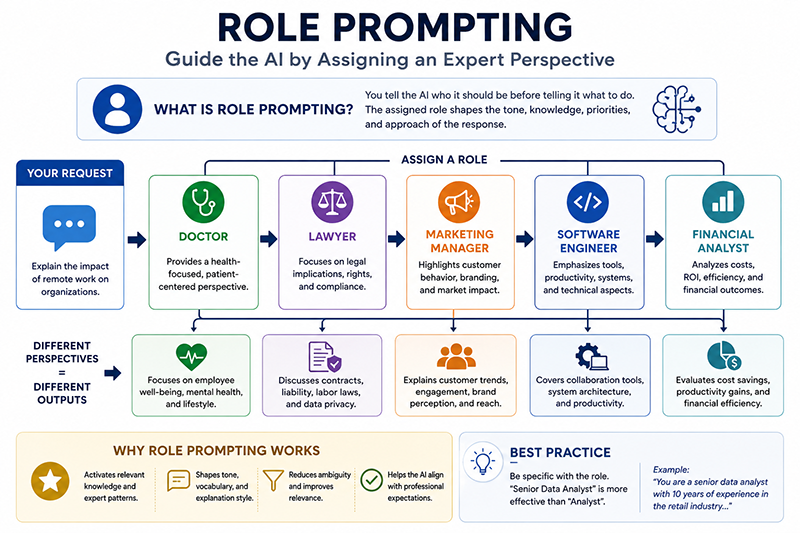
Imagine asking two different people to explain the same topic—perhaps a doctor, a lawyer, or a software engineer. Although they may discuss the same subject, each will approach it differently because of their knowledge, experience, vocabulary, and priorities.
Large Language Models behave in a surprisingly similar way.
One of the simplest yet most effective prompt engineering techniques is Role Prompting, where the user explicitly instructs the AI to respond from the perspective of a particular expert, profession, or persona. Rather than simply asking a question, the prompt begins by defining who the AI should act as before specifying what it should do.
Although both prompts request the same information, the second provides an expert identity that influences the style, terminology, and organization of the response.
Role Prompting builds naturally upon The CLEAR Framework. While CLEAR defines the context, audience, expectations, and response format, Role Prompting strengthens the prompt by establishing the expertise and perspective from which the AI should respond.
Role Prompting is widely used by educators, consultants, researchers, software developers, healthcare professionals, lawyers, marketers, and many other professionals because it often produces responses that are more relevant, realistic, and appropriately detailed.
How Role Prompting Works
Large Language Models are trained on enormous collections of text containing books, research papers, technical documentation, conversations, news articles, legal documents, programming guides, educational materials, and many other forms of writing.
During training, the model learns not only factual information but also the writing styles, terminology, and reasoning patterns associated with different professions and domains.
When you assign the AI a role, you activate these learned patterns.
Teacher
- Explains concepts gradually.
- Provides examples.
- Checks understanding.
Doctor
- Uses clinical reasoning.
- Discusses symptoms and treatments.
- Emphasizes patient safety.
Lawyer
- Considers legal implications.
- Examines multiple interpretations.
- References legal principles.
Financial Analyst
- Evaluates risks.
- Interprets financial data.
- Focuses on evidence and trends.
Although the AI does not actually become a doctor or lawyer, assigning a role encourages it to organize its response using the reasoning style commonly associated with that profession.
Role Prompting can also be combined with other prompting techniques. For example, you can combine Role Prompting with the CLEAR Framework to provide complete task specifications, with Few-shot Prompting to show examples of the desired writing style, or with Chain of Thought Prompting to encourage detailed reasoning from the perspective of the assigned expert.
Examples from Different Professions
Example 1 — Doctor
Why It Is Better: The assigned role influences the tone, vocabulary, and organization of the response. Instead of generating a technical medical description, the AI focuses on patient education, empathy, and practical advice.
Example 2 — Lawyer
Why It Is Better: The AI understands both the legal perspective and the intended audience, resulting in advice that is practical rather than purely academic.
Example 3 — Marketing Manager
Why It Is Better: The role provides a marketing perspective while the audience and product details guide the writing style and key selling points.
Example 4 — Financial Analyst
Why It Is Better: Instead of providing general observations, the AI adopts the structured analytical approach expected from professional investment research.
Example 5 — University Lecturer
Why It Is Better: The role encourages a structured educational explanation while adapting the complexity to the learners' existing knowledge.
Usefulness
Role Prompting is valuable because it improves both the quality and relevance of AI-generated responses.
First, it helps the AI adopt an appropriate communication style. A response written by a teacher naturally differs from one written by a lawyer or software engineer, even when discussing similar topics.
Second, it reduces ambiguity. Without a defined role, the AI must guess which perspective is most appropriate. Assigning an expert role removes much of this uncertainty.
Third, Role Prompting supports professional workflows. Organizations increasingly use AI to generate reports, educational materials, technical documentation, legal summaries, financial analyses, and software documentation. Assigning the correct role helps ensure that the output aligns with professional expectations.
Finally, Role Prompting combines exceptionally well with other prompt engineering techniques. When used alongside the CLEAR Framework, it creates prompts that are both highly structured and contextually appropriate.
Limitations
Although Role Prompting often improves response quality, it has several important limitations.
First, assigning an expert role does not guarantee expertise. The AI generates responses based on learned language patterns rather than genuine professional experience.
Second, highly specialized professions may require additional context. Simply asking the AI to act as a "doctor" or "financial analyst" may not be sufficient if the task involves a very specific medical specialty or financial domain.
Third, users should avoid assuming that AI-generated advice is authoritative simply because it is written from an expert perspective. Critical decisions involving healthcare, law, finance, or public safety should always involve qualified professionals.
Finally, different AI systems may interpret the same role differently depending on their training and alignment methods.
Conclusion
Role Prompting is one of the most accessible and effective techniques in prompt engineering. By assigning the AI a specific professional identity or perspective, users can guide the style, reasoning, vocabulary, and structure of the generated response. Whether preparing lesson plans, financial reports, legal summaries, marketing campaigns, or software documentation, Role Prompting helps produce outputs that are more relevant and professionally appropriate.
However, the role itself is only one part of an effective prompt. The best results are achieved by combining Role Prompting with a clear task, appropriate context, defined constraints, and a suitable response format. Together, these techniques transform prompting from asking simple questions into designing purposeful interactions with AI.
In the next article, we will explore Few-shot Prompting, where you will learn how providing carefully chosen examples can teach an AI the style, structure, and reasoning patterns you expect, often producing even more accurate and consistent results.
Key Takeaways
- Role Prompting assigns the AI a professional identity or perspective before giving it a task.
- Different roles encourage different reasoning styles, vocabulary, and response structures.
- Specific roles generally produce more focused responses than broad or generic roles.
- Role Prompting works best when combined with the CLEAR Framework.
- It is widely applicable across healthcare, law, finance, education, software development, marketing, and many other professions.
- AI does not become a real expert simply because it is assigned an expert role; human judgment and verification remain essential.
- The next article introduces Few-shot Prompting, where carefully selected examples further improve the consistency and quality of AI-generated responses.