

Generative AI
Intermediate
10 min read
ChatGPT
Explore how ChatGPT combines advanced language models with conversational AI to assist with learning, creativity, and problem-solving.
Introduction
The public release of ChatGPT in November 2022 marked one of the most significant milestones in the history of Artificial Intelligence. Although AI researchers had been developing Large Language Models (LLMs) for many years, ChatGPT was the first system to demonstrate to a global audience that conversational AI could be both powerful and accessible. Within just a few months, millions of people were using it to write essays, summarize documents, generate computer code, answer technical questions, brainstorm ideas, and even assist with scientific research.
ChatGPT is an AI assistant developed by OpenAI and built upon the Generative Pre-trained Transformer (GPT) family of language models. At its core, ChatGPT is a Large Language Model that has been trained on vast amounts of text, allowing it to recognize patterns in human language and generate coherent, contextually appropriate responses. Unlike traditional search engines, which primarily retrieve existing information, ChatGPT generates original responses based on the patterns it learned during training.
ChatGPT represents the convergence of many of the concepts introduced in the AI Basics section of this course. It is built using Large Language Models (LLMs), which themselves rely on Deep Learning and Neural Networks. Understanding ChatGPT therefore requires not only an appreciation of what it can do, but also how the underlying technologies work together to create an intelligent conversational system.
Today, ChatGPT is used across education, research, business, software engineering, healthcare, marketing, and many other fields. It has become an important case study in how modern AI systems are transforming the way humans interact with computers. In this article, we will examine how ChatGPT evolved, the technologies that power it, its major capabilities and limitations, and its broader impact on Artificial Intelligence.
The Evolution of ChatGPT
The development of ChatGPT did not happen overnight. It was the result of several years of research into transformer-based language models.
OpenAI introduced the original GPT (Generative Pre-trained Transformer) model in 2018. GPT demonstrated that a transformer neural network could learn general language patterns through large-scale pre-training on text. This was followed by GPT-2, which generated surprisingly fluent text but was initially released cautiously because of concerns about potential misuse. GPT-3, released in 2020, represented a major leap in capability with approximately 175 billion parameters, allowing it to perform a wide range of language tasks with little or no task-specific training.
The release of ChatGPT, based initially on GPT-3.5 and later incorporating GPT-4 and subsequent GPT models, shifted the focus from language generation to natural conversation. Rather than simply predicting the next word in a sentence, ChatGPT was trained to engage in interactive dialogue, maintain conversational context, follow user instructions, and provide responses that are both helpful and coherent.
One of the key innovations behind ChatGPT is instruction tuning. During this stage, the model is further trained using examples of desirable conversations, teaching it to respond to prompts more effectively than a model trained only through next-word prediction.
Another important development is Reinforcement Learning from Human Feedback (RLHF). After the model generates responses, human evaluators compare different outputs and indicate which responses are more useful, accurate, or appropriate. These evaluations are then used to further improve the model through reinforcement learning.
Modern versions of ChatGPT have expanded far beyond simple text generation. Many versions now support multimodal interaction, meaning they can understand and generate multiple forms of information, including text, images, voice, and in some cases other data formats. This represents an important step toward AI systems that can interact with the world in richer and more flexible ways.
ChatGPT has also evolved into an extensible AI platform capable of using external tools, browsing the web, analyzing uploaded files, writing and executing code in controlled environments, and integrating with third-party applications. These capabilities move ChatGPT beyond being simply a chatbot toward becoming an intelligent AI assistant.
However, ChatGPT is not the only approach to conversational AI. As researchers continued improving language models, different organizations developed their own design philosophies. In the next article, we will examine Claude, developed by Anthropic, which places particular emphasis on reasoning, long-context understanding, and AI safety through an approach known as Constitutional AI.
Capabilities and Technical Foundations
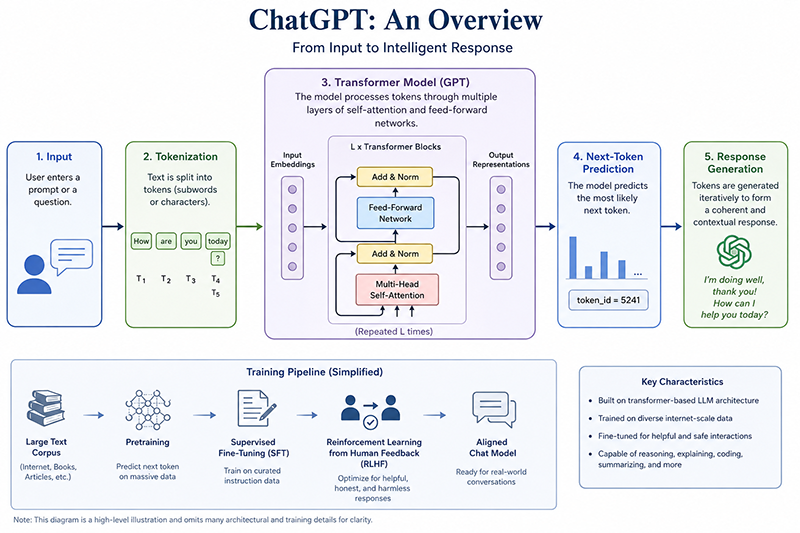
Although ChatGPT appears to converse naturally, it does not think or reason in the same way humans do. Instead, it uses an enormous transformer neural network to predict the most appropriate sequence of tokens based on the conversation history.
The transformer architecture, introduced in 2017, revolutionized Natural Language Processing because it allows the model to analyze relationships between many words simultaneously. This enables ChatGPT to maintain context across lengthy conversations, identify relationships between concepts, and generate responses that are often remarkably coherent.
Training ChatGPT occurs in two major stages.
The first stage is pre-training, during which the model processes enormous collections of publicly available text. During this stage, it learns grammar, vocabulary, writing styles, factual relationships, logical structures, and many other statistical patterns of language.
The second stage is alignment, during which techniques such as instruction tuning and RLHF help shape the model into an assistant that better follows user requests while avoiding harmful or undesirable outputs.
Modern ChatGPT systems also incorporate capabilities that extend beyond the core language model itself. These include memory features that allow the assistant to remember user preferences across conversations, tool use that enables interaction with external systems, and Retrieval-Augmented Generation (RAG), where external knowledge sources can supplement the model's internal knowledge when appropriate.
One of ChatGPT's greatest strengths is its versatility. Unlike traditional AI systems designed for one specific task, ChatGPT performs reasonably well across an exceptionally wide variety of activities. It can explain scientific concepts, summarize research papers, translate languages, generate software code, assist with mathematics, draft reports, create lesson plans, analyze business data, and support creative writing.
This flexibility has led many organizations to adopt ChatGPT as a productivity tool rather than simply a conversational chatbot.
Despite these impressive capabilities, ChatGPT also has important limitations.
Like all Large Language Models, ChatGPT may occasionally produce hallucinations, generating responses that sound convincing but are factually incorrect. It can misunderstand ambiguous instructions, inherit biases from its training data, or provide incomplete explanations for highly specialized subjects.
For this reason, users should view ChatGPT as an intelligent assistant rather than an unquestionable authority. Critical thinking, fact-checking, and domain expertise remain essential when using AI-generated information.
As conversational AI continues to evolve, developers are increasingly focusing on reasoning, planning, long-context understanding, and integration with external tools. These developments are shaping the next generation of AI assistants and will likely redefine how humans collaborate with intelligent systems over the coming years.
Conclusion
ChatGPT represents one of the most influential developments in the recent history of Artificial Intelligence. By combining transformer-based language models, large-scale pre-training, instruction tuning, and Reinforcement Learning from Human Feedback, OpenAI created a conversational AI system that fundamentally changed public perceptions of what AI could accomplish.
Beyond its technical achievements, ChatGPT demonstrated that sophisticated AI could become a practical assistant for millions of users across education, business, research, and everyday life. It also accelerated global investment in AI research, inspiring competing systems and driving rapid innovation throughout the field.
While ChatGPT remains one of the most widely used AI assistants, it is only one approach to building trustworthy conversational AI. In the next article, we will explore Claude, whose developers pursued a different philosophy centered on Constitutional AI, safety, and advanced reasoning capabilities. Comparing these systems provides valuable insight into the diverse approaches shaping the future of Artificial Intelligence.
Key Takeaways
- ChatGPT is an AI assistant developed by OpenAI and built upon the GPT family of Large Language Models.
- It combines transformer-based language models with instruction tuning and Reinforcement Learning from Human Feedback (RLHF) to create natural conversational experiences.
- Modern versions of ChatGPT support multimodal interaction, tool use, file analysis, coding assistance, and integration with external services.
- ChatGPT is highly versatile and is widely used in education, business, research, software development, and creative work.
- Like all Large Language Models, ChatGPT can produce inaccurate information, misunderstand context, and reflect biases present in training data.
- Effective prompting significantly improves response quality by providing clear objectives and sufficient context.
- ChatGPT helped popularize conversational AI, but alternative approaches such as Claude demonstrate that different design philosophies can produce different strengths in modern AI assistants.