

Prompt Engineering
Intermediate
8 min read
Few Shot Prompting
Teach AI through carefully chosen examples to generate more accurate, consistent, and reliable results.
Introduction
Imagine teaching a new employee how to complete a task. Rather than explaining every rule in detail, you might simply show them two or three examples of correctly completed work. From those examples, they quickly recognize the pattern and apply it to new situations.
Large Language Models work in a remarkably similar way.
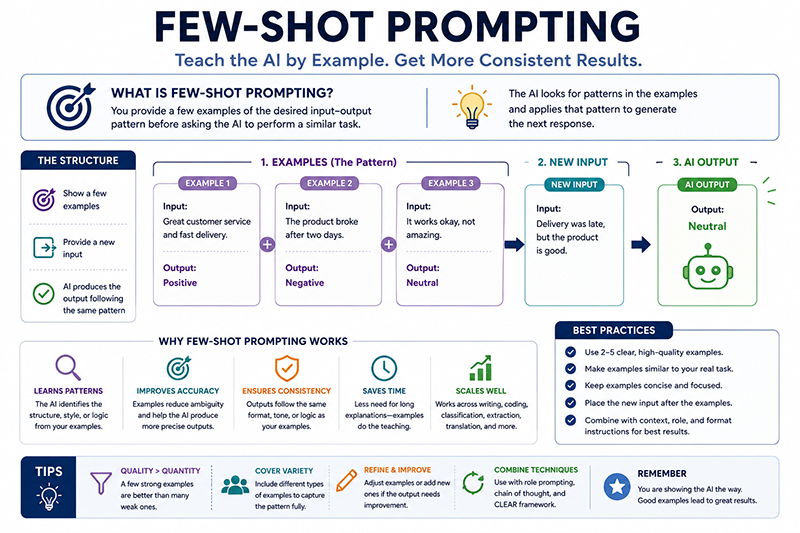
Few-shot Prompting is a prompt engineering technique in which the user provides a small number of examples before asking the AI to perform a similar task. Instead of describing every formatting rule or stylistic preference, the user demonstrates the desired pattern through examples, allowing the model to imitate it.
Few-shot Prompting has become one of the most effective techniques for improving consistency, especially when tasks involve specific writing styles, structured outputs, classifications, translations, or formatting conventions.
A stronger approach would be to first provide three well-written product descriptions before asking the AI to write a fourth one using the same style.
The AI does not memorize these examples. Instead, it identifies the underlying pattern and applies it to the new task.
Few-shot Prompting builds naturally upon the techniques introduced earlier in this category. The CLEAR Framework provides structure, while Role Prompting establishes perspective. Few-shot Prompting extends both techniques by demonstrating the exact style, structure, or reasoning process the user expects.
Because humans also learn effectively from examples, Few-shot Prompting often feels intuitive and produces remarkably consistent results across many professional tasks.
How Few-shot Prompting Works
Large Language Models are designed to identify patterns.
When several examples appear together in a prompt, the model searches for similarities in vocabulary, sentence structure, formatting, reasoning style, and organization. It then predicts how the next example should look based on those observed patterns.
Suppose you provide three examples like this:
Positive Review → Positive
Poor Customer Service → Negative
Average Experience → Neutral
Then ask the AI to classify:
The AI immediately recognizes the pattern and produces:
Without needing a lengthy explanation of sentiment analysis, the examples themselves become part of the instructions.
Few-shot Prompting is particularly effective when there is a consistent pattern that can be demonstrated through a handful of examples. These include:
- Document classification
- Summarization
- Email writing
- Data extraction
- Translation
- Customer support
- Programming
- Lesson planning
- Report writing
Unlike traditional programming, where every rule must be explicitly coded, Few-shot Prompting allows the AI to infer many of the rules directly from the examples.
Examples from Different Professions
Example 1 — Teacher
Improved Prompt: Below are examples of learning objectives written using the Cambridge curriculum style.
Example 1: Students will identify the main parts of a flowering plant.
Example 2: Students will compare the properties of solids and liquids through observation.
Now write five learning objectives for a lesson introducing the water cycle to Grade 4 students using the same style.
Why It Is Better: Instead of guessing the preferred writing style, the AI learns the expected structure directly from the examples, producing objectives that are consistent with previous lesson plans.
Example 2 — Financial Analyst
Improved Prompt: Here are two executive summaries from previous quarterly financial reports.
Example 1: [Executive Summary A]
Example 2: [Executive Summary B]
Using the same tone, structure, and level of detail, prepare an executive summary for the attached Q3 financial report.
Why It Is Better: The examples teach the AI how management prefers financial summaries to be written, leading to more consistent reporting across the organization.
Example 3 — Human Resources Manager
Improved Prompt: Here are three examples of interview evaluation summaries used by our HR department.
Example 1...
Example 2...
Example 3...
Write an evaluation for the following candidate using the same format, tone, and scoring style.
Why It Is Better: The AI learns the organization's preferred evaluation format rather than producing generic interview comments.
Example 4 — Customer Support Specialist
Improved Prompt: Below are three examples of customer service responses that reflect our company's communication policy.
Example 1...
Example 2...
Example 3...
Respond to the following customer complaint using the same professional tone and structure.
Why It Is Better: The examples demonstrate the organization's preferred communication style, helping maintain consistency across different customer interactions.
Example 5 — Software Engineer
Improved Prompt: Here are two examples of API documentation used throughout our software project.
Example 1...
Example 2...
Document the following authentication endpoint using the same headings, formatting, and level of technical detail.
Why It Is Better: Rather than inventing a documentation style, the AI follows the established documentation standards already used within the project.
Usefulness
Few-shot Prompting is particularly valuable because it reduces the need to describe complex formatting rules explicitly. Instead of explaining every detail, users simply demonstrate what they want through carefully selected examples.
This technique is especially useful when consistency is important.
Organizations often have established templates, writing styles, branding guidelines, documentation standards, or reporting formats. Providing examples allows the AI to reproduce these patterns with much greater accuracy than relying on verbal instructions alone.
Few-shot Prompting also improves reliability for classification tasks, structured outputs, and repetitive workflows. By observing several examples, the model often generalizes the desired pattern more accurately than it would from a single instruction.
Another important advantage is that Few-shot Prompting combines naturally with earlier techniques.
For example, a prompt might first apply the CLEAR Framework to establish the task, assign a professional perspective using Role Prompting, and then provide several examples through Few-shot Prompting. These techniques complement one another rather than competing.
Limitations
Despite its effectiveness, Few-shot Prompting also has limitations.
First, poor examples produce poor results. If the examples contain mistakes, inconsistent formatting, or unclear reasoning, the AI may reproduce those weaknesses.
Second, examples consume part of the model's context window. Very large examples leave less space for the actual task, particularly when working with lengthy documents.
Third, the AI may sometimes imitate superficial features while overlooking deeper patterns. Careful selection of representative examples therefore becomes important.
Finally, examples should reflect the diversity of tasks the user expects the AI to perform. Using only one narrow type of example may unintentionally limit the model's flexibility.
Conclusion
Few-shot Prompting demonstrates one of the most natural ways of communicating with Artificial Intelligence: teaching by example. Rather than attempting to describe every rule, users provide representative examples that allow the AI to infer the desired pattern, writing style, or reasoning process.
Whether preparing lesson plans, financial reports, HR evaluations, customer communications, or software documentation, carefully chosen examples often produce responses that are more accurate, consistent, and aligned with organizational standards.
As prompt engineering techniques become more sophisticated, examples alone may not always be sufficient. Some problems require the AI to show its reasoning process explicitly. In the next article, we will explore Chain of Thought Prompting, a technique that encourages AI systems to solve complex problems through structured, step-by-step reasoning.
Key Takeaways
- Few-shot Prompting teaches AI through examples rather than lengthy explanations.
- The AI identifies patterns in the provided examples and applies those patterns to new tasks.
- This technique is particularly useful for structured writing, document classification, software documentation, customer support, and standardized reporting.
- High-quality examples generally produce higher-quality outputs.
- Few-shot Prompting combines effectively with both the CLEAR Framework and Role Prompting.
- Carefully selected examples improve consistency across professional workflows.
- The next article introduces Chain of Thought Prompting, where the focus shifts from learning patterns to encouraging structured reasoning.