
Generative AI
Intermediate
10 min read
Gemini
Learn how Gemini combines text, images, audio, video, and code through a native multimodal AI architecture.
Introduction
As Artificial Intelligence continued to evolve, researchers began to recognize that future AI systems would need to understand much more than text alone. Humans naturally combine language with images, audio, video, diagrams, and code when communicating and solving problems. Building separate AI models for each type of information was possible, but it often resulted in fragmented user experiences and limited collaboration between different AI capabilities.
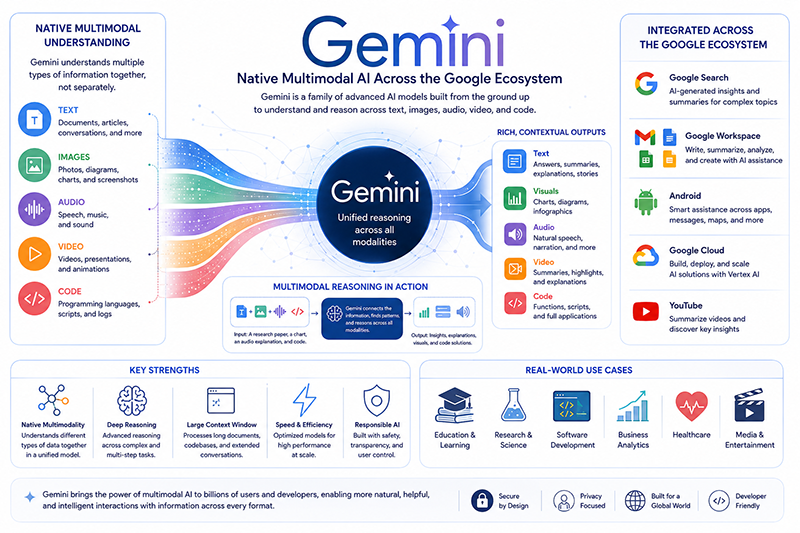
Google addressed this challenge with Gemini, its next-generation family of multimodal Large Language Models. Developed by Google DeepMind, Gemini was designed from the outset to process and reason across multiple forms of information within a single architecture. Rather than treating text, images, audio, and video as separate tasks, Gemini attempts to understand them together, allowing richer interactions and more comprehensive reasoning.
Like ChatGPT and Claude, Gemini is built upon transformer-based Large Language Models and represents another evolution of the concepts introduced in Large Language Models (LLMs). However, its defining characteristic is its native multimodal design, enabling it to work with different types of information as part of a unified reasoning process.
Gemini has become deeply integrated into Google's ecosystem, supporting products such as Google Search, Workspace, Android, Google Cloud, and numerous developer services. This integration has transformed Gemini from a standalone chatbot into an intelligent assistant embedded throughout one of the world's largest technology platforms.
As organizations increasingly work with diverse forms of digital information, multimodal AI is becoming an essential direction for the future of Artificial Intelligence. Gemini provides an excellent example of how AI assistants are evolving beyond conversational text generation toward broader forms of intelligent interaction.
A Native Multimodal AI
One of Gemini's most significant innovations is its native multimodal architecture.
Traditional AI systems often combined several specialized models—one for text, another for images, another for speech, and so on. Although these systems could work together, they frequently required additional processing to transfer information between models. Gemini approaches the problem differently by learning relationships between multiple data types within a unified model.
This allows Gemini to perform tasks that require understanding different kinds of information simultaneously. For example, a user might upload a scientific graph, ask questions about its trends, request an explanation of the underlying mathematical relationships, and then ask Gemini to generate presentation slides summarizing the results. Rather than treating these as separate tasks, Gemini reasons across the entire collection of inputs.
This capability is particularly valuable in education, engineering, medicine, scientific research, and business, where information is rarely limited to plain text.
Like other Large Language Models, Gemini uses the transformer architecture, which you first encountered in ChatGPT. Transformers allow the model to identify relationships between different pieces of information through mechanisms known as attention, enabling the model to determine which parts of the input are most relevant when generating a response.
Gemini extends this concept beyond language by allowing attention mechanisms to operate across different types of media. Images, diagrams, spoken language, and written text can all contribute to the model's reasoning process.
Another important feature is Gemini's ability to generate computer code while simultaneously explaining the logic behind that code. This has made it particularly useful for software development, technical education, debugging, and algorithm design.
Like Claude, Gemini also supports increasingly large context windows, enabling it to analyze lengthy documents, multiple files, and complex conversations while maintaining consistency throughout the interaction.
Google has also developed multiple versions of Gemini to meet different computational needs. Smaller models can run efficiently on mobile devices, while larger models provide advanced reasoning capabilities through cloud-based infrastructure. This scalability allows developers to choose models that balance performance, speed, and computing cost according to their specific applications.
Integration Across the Google Ecosystem
One of Gemini's greatest strengths is its integration with Google's extensive ecosystem of products and services.
Rather than existing only as an independent chatbot, Gemini enhances applications that millions of people already use every day.
Within Google Workspace, Gemini assists users in writing emails, summarizing meetings, generating spreadsheets, preparing presentations, and organizing documents. In Google Search, AI-generated summaries help users quickly understand complex topics while still providing access to original information sources. On Android, Gemini increasingly functions as an intelligent assistant capable of interacting with apps, calendars, messages, maps, and other device features.
For software developers, Gemini integrates with Google AI Studio, Vertex AI, and other cloud-based development platforms. These services allow organizations to build custom AI applications, fine-tune models, connect external knowledge bases, and deploy enterprise-scale AI systems.
An important concept within enterprise AI is context caching.
Normally, AI models repeatedly process the same background information every time a user submits a request. Context caching stores frequently used context so it can be reused efficiently across multiple interactions. This reduces computation, lowers cost, and improves response speed, particularly when working with large documents or long-running conversations.
Gemini also supports sophisticated tool use, allowing the model to access external services, retrieve current information, execute specialized functions, and coordinate multi-step workflows. These capabilities are becoming increasingly important as AI assistants evolve from conversational systems into intelligent digital collaborators.
Despite these impressive capabilities, Gemini shares many limitations common to all Large Language Models.
Like ChatGPT and Claude, Gemini can generate inaccurate information, misunderstand ambiguous requests, or produce biased responses if its training data contains underlying biases. Multimodal reasoning also introduces new challenges because the model must correctly interpret relationships between different media types, each with its own sources of uncertainty.
Furthermore, integrating AI across widely used consumer products raises important questions regarding privacy, transparency, data governance, and responsible AI deployment. Organizations adopting multimodal AI must therefore balance innovation with careful consideration of ethical and regulatory responsibilities.
Gemini illustrates how AI assistants are becoming increasingly integrated into everyday workflows rather than existing as isolated applications. As AI continues to mature, seamless collaboration between humans, software, and intelligent assistants is likely to become the norm.
The next stage of this evolution can be seen in Copilot, where AI moves beyond conversation and becomes deeply embedded within productivity software, software engineering environments, and enterprise business processes.
Conclusion
Gemini represents an important milestone in the evolution of Artificial Intelligence by demonstrating the potential of native multimodal reasoning. Instead of focusing exclusively on language, Gemini integrates text, images, audio, video, and code within a unified architecture, enabling more comprehensive understanding and richer forms of interaction.
Building upon the conversational capabilities popularized by ChatGPT and the safety-oriented design philosophy of Claude, Gemini expands the role of AI by embedding intelligent assistance throughout Google's ecosystem of consumer and enterprise products. Its multimodal architecture illustrates how future AI systems may increasingly resemble general-purpose reasoning assistants capable of working across diverse sources of information.
In the next article, we will explore Copilot, Microsoft's AI assistant, and examine how conversational AI is transforming productivity software, software development, and enterprise workflows through deep integration with professional tools.
Key Takeaways
- Gemini is a family of Large Language Models developed by Google DeepMind.
- Gemini was designed as a native multimodal AI, capable of understanding text, images, audio, video, and code within a unified architecture.
- It uses transformer-based neural networks with attention mechanisms that operate across multiple forms of information.
- Gemini is deeply integrated into Google products including Search, Workspace, Android, Google Cloud, and developer platforms.
- Features such as context caching and advanced tool use improve efficiency and support complex enterprise workflows.
- Like other Large Language Models, Gemini can still produce inaccurate information and requires careful human oversight.
- Gemini demonstrates the growing importance of multimodal reasoning, while the next article explores how Microsoft applies similar AI technologies within professional productivity environments through Copilot.