

AI Ethics
Beginner
8 min read
Responsible AI Governance
Discover how responsible AI governance helps organizations build fair, transparent, accountable, and trustworthy AI systems throughout their entire lifecycle.
Introduction
Artificial Intelligence is transforming nearly every sector of society, from healthcare and education to finance, manufacturing, transportation, and scientific research. As AI systems become more capable and increasingly involved in important decisions, organizations face a critical responsibility: ensuring that these systems are developed, deployed, and monitored in ways that are ethical, transparent, and accountable.
This responsibility extends beyond writing accurate algorithms or collecting large datasets. It requires organizations to establish policies, processes, and oversight mechanisms that guide how AI systems are designed, evaluated, and used throughout their entire lifecycle.
This comprehensive approach is known as Responsible AI Governance.
Governance does not refer to a single technology or software tool. Instead, it is the framework that helps organizations answer important questions:
- Is this AI system fair?
- Can its decisions be explained?
- Who is accountable if something goes wrong?
- How is personal data protected?
- When should humans review AI recommendations?
- How should the system be monitored after deployment?
This article brings together ideas introduced throughout the AI Ethics series, including Bias in AI: Why Machines Aren't Neutral, The Black Box Problem: Can We Trust What We Don't Understand?, and Human-in-the-Loop AI, demonstrating how organizations integrate these principles into responsible AI practices.
What Is AI Governance?
AI governance refers to the policies, standards, procedures, and oversight mechanisms that guide how artificial intelligence is developed, deployed, and managed.
Just as organizations establish financial regulations, cybersecurity policies, and quality assurance procedures, they also need governance frameworks that define how AI should be used responsibly.
Rather than focusing solely on technical performance, governance considers broader questions involving ethics, legal compliance, risk management, and public trust.
A well-governed AI system should not only produce accurate predictions but should also operate in ways that are fair, understandable, secure, and aligned with organizational values.
Governance therefore combines technical expertise with ethical decision-making and organizational leadership.
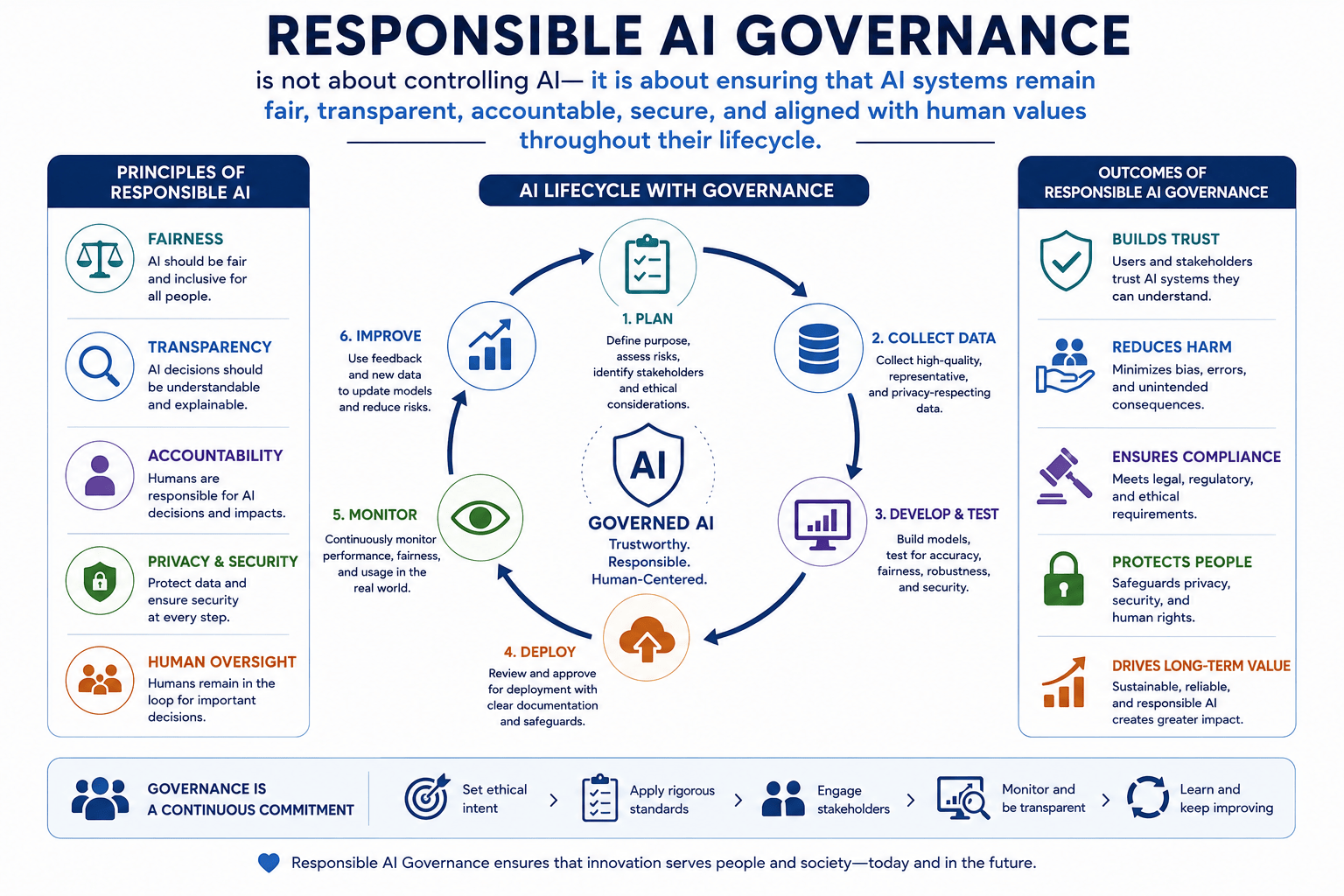
The Pillars of Responsible AI Governance
Although governance frameworks vary across organizations, several core principles appear consistently.
Fairness
Organizations evaluate whether AI systems perform equitably across different populations and actively work to reduce unintended bias.
This includes using representative datasets, testing performance across diverse groups, and regularly auditing deployed systems.
Transparency
Users should understand when AI is involved in decision-making and, whenever appropriate, receive understandable explanations for important recommendations.
Transparent documentation also helps developers, regulators, and auditors understand how AI systems were designed and evaluated.
Accountability
Every AI system should have clearly identified human responsibility.
Organizations must determine who approves deployment, monitors performance, investigates problems, and authorizes significant updates.
Responsibility ultimately belongs to people—not algorithms.
Privacy and Security
Many AI systems rely on sensitive personal information.
Responsible governance requires protecting this data through appropriate security measures, access controls, and privacy-preserving practices while complying with applicable laws and regulations.
Human Oversight
As discussed in the previous article, meaningful human involvement remains essential for high-stakes applications.
Governance frameworks define when AI recommendations require expert review before important decisions are implemented.
AI Governance Throughout the Lifecycle
Responsible governance is not a single approval step before deployment. Instead, it applies throughout the AI lifecycle.
Planning
Organizations define the problem, evaluate risks, identify stakeholders, and determine whether AI is the appropriate solution.
Potential ethical concerns are considered before development begins.
Data Collection
Teams evaluate data quality, diversity, privacy requirements, and potential sources of bias.
Sensitive information is handled according to organizational policies and legal requirements.
Model Development
Developers train AI models while evaluating accuracy, fairness, robustness, explainability, and security.
Independent testing helps identify weaknesses before deployment.
Deployment
Before releasing an AI system, organizations often conduct governance reviews to verify that technical, ethical, legal, and operational requirements have been satisfied.
Continuous Monitoring
AI systems operate in changing environments.
Governance therefore requires ongoing monitoring for performance degradation, data drift, emerging biases, cybersecurity threats, and changing regulations.
Rather than treating deployment as the end of development, Responsible AI views it as the beginning of continuous oversight.
Responsible AI in Different Industries
Healthcare
Hospitals evaluate AI systems for diagnostic accuracy while ensuring patient privacy, physician oversight, and regulatory compliance.
Governance helps maintain patient safety and clinical accountability.
Finance
Banks monitor AI systems used for fraud detection, credit assessment, and financial forecasting.
Governance promotes fairness, transparency, and compliance with financial regulations.
Education
Educational institutions ensure that AI supports learning without introducing unfair assessment practices or compromising student privacy.
Teachers remain responsible for interpreting AI recommendations.
Government
Public sector organizations increasingly establish governance frameworks to ensure transparency, explainability, accountability, and public trust when AI assists public services.
Scientific Research
Research institutions emphasize reproducibility, transparency, ethical review, and responsible data management to maintain confidence in AI-assisted discoveries.
Challenges of AI Governance
Implementing effective governance is not always straightforward.
First, AI technologies evolve rapidly.
Governance policies must adapt continuously as new capabilities, risks, and regulations emerge.
Second, organizations often operate internationally.
Different countries may have different legal requirements regarding privacy, fairness, transparency, and AI regulation.
Third, balancing innovation with responsibility requires thoughtful decision-making.
Excessive restrictions may slow beneficial innovation, while insufficient oversight may increase risks to individuals and society.
Finally, governance involves many stakeholders.
Engineers, data scientists, legal experts, ethicists, managers, regulators, and end users all contribute different perspectives that must be integrated into responsible decision-making.
The Future of Responsible AI
Around the world, governments, universities, technology companies, and international organizations are developing principles and standards for trustworthy AI.
Increasingly, organizations recognize that responsible AI is not merely a regulatory requirement—it is a competitive advantage.
Systems that demonstrate fairness, transparency, accountability, and respect for privacy are more likely to earn public trust and achieve long-term success.
Future governance frameworks will likely become more proactive, using continuous auditing, automated monitoring, standardized documentation, and stronger collaboration between technical experts and policymakers.
Ultimately, Responsible AI Governance seeks to ensure that technological progress remains aligned with human values.
Conclusion
Artificial Intelligence offers extraordinary opportunities to improve decision-making, increase efficiency, and solve complex problems. However, these benefits can only be fully realized when AI systems are developed and used responsibly.
Responsible AI Governance provides the structure that allows organizations to balance innovation with ethical responsibility. By integrating fairness, transparency, accountability, privacy, human oversight, and continuous monitoring throughout the AI lifecycle, organizations can build systems that earn public confidence while reducing unnecessary risks.
Rather than limiting innovation, effective governance enables trustworthy innovation.
As AI continues to evolve, responsible governance will remain one of the most important foundations for ensuring that artificial intelligence serves individuals, organizations, and society in fair, transparent, and beneficial ways.
Key Takeaways
- Responsible AI Governance provides the policies and oversight needed to develop and manage AI ethically and responsibly.
- Governance integrates fairness, transparency, accountability, privacy, human oversight, and continuous monitoring.
- Responsible AI applies throughout the entire AI lifecycle, from planning and data collection to deployment and ongoing evaluation.
- Human accountability remains essential even when AI systems perform highly automated tasks.
- Effective governance builds public trust while supporting innovation and regulatory compliance.
- Responsible AI is an ongoing organizational commitment rather than a one-time technical review.
- Together, the principles explored throughout this AI Ethics series provide a strong foundation for developing AI systems that are both powerful and trustworthy.