

AI Ethics
Beginner
8 min read
Explainable AI
Understanding how AI makes decisions is essential for building trust, accountability, and responsible AI in high-stakes applications.
Introduction
Artificial Intelligence has achieved remarkable success in tasks ranging from language translation and medical diagnosis to financial forecasting and image recognition. Many modern AI systems can identify complex patterns that would be difficult—or even impossible—for humans to detect. Yet this growing capability introduces an important challenge: what happens when an AI produces an answer but cannot clearly explain how it reached that conclusion?
This challenge is known as the Black Box Problem.
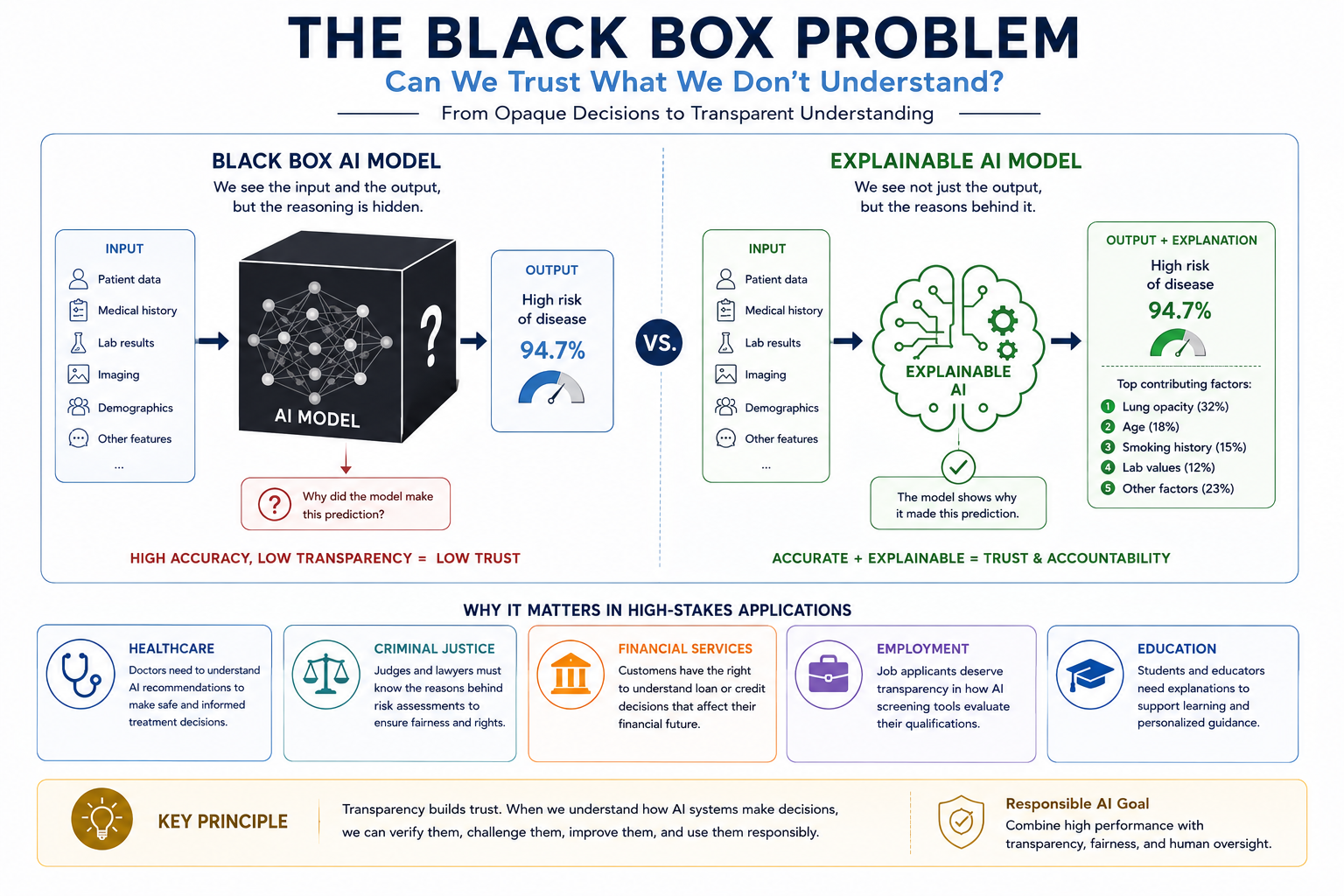
In computing, a "black box" refers to a system whose internal workings are hidden from the user. Inputs enter the system, outputs emerge, but the reasoning process between them remains difficult to observe or understand. While many AI models produce highly accurate predictions, some of their internal decision-making processes are so mathematically complex that even their developers cannot fully explain why a particular decision was made.
The Black Box Problem becomes especially important when AI influences decisions involving healthcare, education, finance, employment, or criminal justice. In these situations, accuracy alone may not be sufficient. People also want to understand why a recommendation was made, whether it can be trusted, and whether it was fair.
This article builds upon the previous discussion of Bias in AI: Why Machines Aren't Neutral. While bias focuses on whether AI makes fair decisions, explainability asks whether humans can understand those decisions. Together, these principles form an important foundation of Responsible AI.
What Is the Black Box Problem?
Not all AI systems are equally difficult to understand. Some traditional Machine Learning models, such as simple decision trees or linear regression models, allow developers to trace exactly how an output was produced. Each decision follows a logical sequence that humans can inspect and verify.
Modern Deep Learning models, however, often contain millions—or even billions—of interconnected parameters. These parameters interact in highly complex ways, making it difficult to identify the precise contribution of any individual calculation.
Imagine asking a skilled physician why they suspect a patient has a particular illness. The physician can usually explain the symptoms, medical history, and diagnostic evidence that influenced the decision.
Now imagine receiving the same diagnosis from an AI system that simply states:
Although the prediction may be accurate, many people would hesitate to rely on it without additional explanation. This lack of transparency is the essence of the Black Box Problem.
Explainability and Interpretability
The terms explainability and interpretability are often used interchangeably, but they describe slightly different ideas.
Interpretability refers to how easily humans can understand how a model works. Some models are naturally transparent because their reasoning can be directly examined.
Explainability, often called Explainable AI (XAI), refers to methods that help humans understand complex AI systems whose internal processes are difficult to interpret directly.
In other words:
- Interpretable models are understandable by design.
- Explainable AI helps make complex models easier to understand after they have been built.
For example, an explainable AI system might highlight which patient symptoms most strongly influenced a diagnosis or identify which regions of an X-ray image contributed most to its prediction.
Rather than exposing every mathematical calculation, Explainable AI provides meaningful insights that humans can understand.
Why Some AI Decisions Are Difficult to Explain
Several factors contribute to the Black Box Problem.
Complex Neural Networks
Deep Learning models often consist of many interconnected layers containing millions of parameters.Each parameter contributes only a small part to the final prediction, but together they create highly sophisticated decision-making capabilities.
The result is impressive performance, but reduced transparency.
Learning Statistical Patterns
AI systems do not reason like humans. Instead, they identify statistical relationships within enormous datasets. Because these relationships are distributed across many parameters rather than stored as explicit rules, the reasoning process becomes difficult to describe in everyday language.Emergent Behavior
Large Language Models (LLMs) demonstrate abilities that were not explicitly programmed by developers.As models become larger and more capable, they sometimes solve problems in unexpected ways, making their internal reasoning even more difficult to interpret.
Why Explainability Matters
Healthcare
A physician using AI to detect cancer from medical images needs more than a prediction. Understanding which regions of the image influenced the diagnosis helps doctors verify the recommendation and identify potential errors.
Explainable AI therefore supports—not replaces—clinical judgment.
Financial Services
When an AI system rejects a loan application, customers may reasonably ask why.
Providing understandable explanations improves transparency, helps organizations demonstrate fairness, and allows applicants to correct inaccurate information when appropriate.
Criminal Justice
Risk assessment systems may assist judges by estimating the likelihood of reoffending. Because these recommendations can influence sentencing or parole decisions, transparency is essential.
Judges, lawyers, and defendants should understand the factors that contributed to an AI recommendation rather than accepting it without question.
Recruitment
Organizations increasingly use AI to screen job applications. If applicants are rejected without any understandable explanation, it becomes difficult to determine whether the decision was based on relevant qualifications or whether unintended bias influenced the outcome.
Explainability promotes accountability.
Scientific Research
Researchers often use AI to identify patterns within complex datasets. Being able to explain these discoveries allows other scientists to verify findings, reproduce results, and build confidence in AI-assisted research.
Building More Transparent AI
Researchers are actively developing methods that improve AI transparency without sacrificing performance. One approach involves selecting interpretable models whenever they provide sufficient accuracy for the task.
When more complex models are necessary, Explainable AI techniques can identify the factors that most influenced a prediction.
Organizations also increasingly document how AI systems are developed, tested, and monitored. These documents describe training data, intended use cases, known limitations, evaluation methods, and potential risks.
Human oversight remains equally important. Rather than allowing AI to make fully autonomous decisions, many organizations require qualified professionals to review AI recommendations before taking action. Transparency is therefore achieved through a combination of technology, documentation, governance, and human judgment.
Limitations of Explainable AI
Although Explainable AI has made significant progress, important challenges remain.
First, explanations are often simplified representations of extremely complex mathematical processes. An explanation may accurately summarize the model's behavior without capturing every internal calculation.
Second, different Explainable AI techniques may generate different explanations for the same prediction.
Finally, improving explainability sometimes involves trade-offs.
Highly interpretable models may not always achieve the same predictive performance as more complex Deep Learning systems. Organizations must therefore balance accuracy, transparency, fairness, and practicality according to the requirements of each application.
Conclusion
As AI becomes increasingly integrated into society, trust depends on more than impressive performance. People want confidence that AI systems make decisions fairly, responsibly, and for understandable reasons.
The Black Box Problem reminds us that accuracy alone is not enough. In domains where AI influences healthcare, education, finance, employment, or justice, explainability helps people evaluate recommendations, identify errors, challenge unfair outcomes, and maintain accountability.
Responsible AI therefore requires more than powerful algorithms—it requires transparency that allows humans to remain informed decision-makers.
In the next article, we will explore Human-in-the-Loop AI, examining why combining human expertise with artificial intelligence often produces safer, more accountable, and more trustworthy outcomes.
Key Takeaways
- The Black Box Problem refers to AI systems whose internal reasoning is difficult for humans to understand.
- Interpretability means a model is understandable by design, while Explainable AI (XAI) provides tools to explain complex models.
- Modern Deep Learning systems often achieve high performance at the cost of reduced transparency.
- Explainability is particularly important in healthcare, finance, recruitment, education, and criminal justice.
- Transparent AI improves accountability, trust, and responsible decision-making.
- Explainability complements human expertise rather than replacing it.
- Responsible AI balances accuracy, fairness, transparency, and human oversight to support trustworthy outcomes.