

Generative AI
Intermediate
10 min read
Claude
Discover how Claude emphasizes safe, thoughtful reasoning through Constitutional AI and long-context understanding.
Introduction
As conversational AI rapidly evolved following the success of ChatGPT, researchers began asking an important question: Can an AI assistant become more helpful while also becoming safer, more transparent, and better at reasoning? One of the most influential answers to this question came from Anthropic, an AI research company founded in 2021 by former members of OpenAI. Their flagship conversational AI system, Claude, represents a different philosophy for building Large Language Models—one that places strong emphasis on safety, reasoning, and human-centered design.
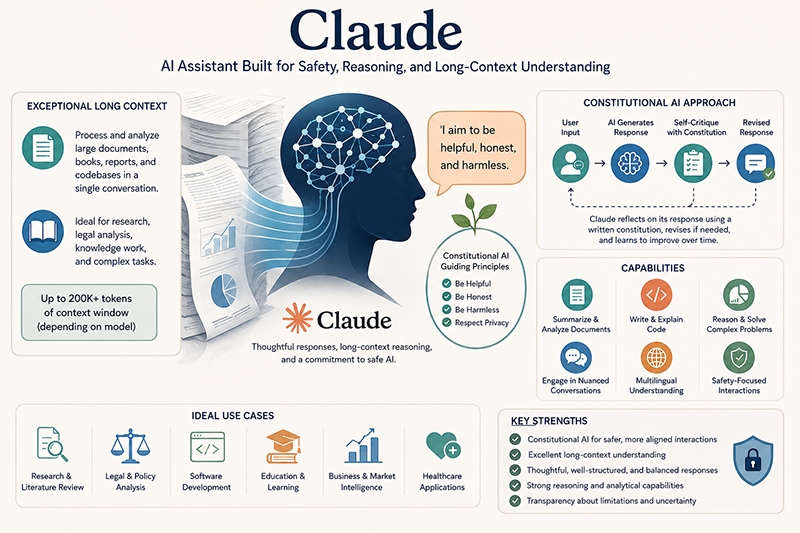
Like ChatGPT, Claude is built upon transformer-based Large Language Models and uses the principles introduced in Large Language Models (LLMs). However, rather than relying primarily on Reinforcement Learning from Human Feedback (RLHF), Anthropic developed an alternative alignment technique known as Constitutional AI. This approach aims to make AI systems more helpful, honest, and harmless by allowing them to evaluate their own responses against a predefined set of ethical principles.
Today, Claude is widely used for research, writing, programming, document analysis, business applications, and academic work. It is particularly recognized for its ability to process very long documents, maintain coherent reasoning across extended conversations, and generate balanced, well-structured responses.
As AI assistants continue to evolve, Claude demonstrates that improvements in intelligence are not measured solely by larger models or faster responses. Equally important are the methods used to align AI behavior with human values and expectations.
Constitutional AI and Long-Context Reasoning
One of Claude's defining innovations is Constitutional AI. Traditional language models are often aligned using human feedback, where reviewers compare different responses and indicate which one is preferable. Claude still incorporates human feedback, but Constitutional AI adds another layer of supervision.
Instead of relying exclusively on human evaluators, Claude is trained to assess its own responses according to a written "constitution"—a collection of principles that encourage honesty, fairness, respect, and the avoidance of harmful content. During training, the model generates responses, critiques them according to these principles, revises them, and gradually learns to produce answers that better align with the constitution.
This approach offers several advantages. Human reviewers do not need to manually evaluate every possible scenario, making the alignment process more scalable while encouraging the model to explain its reasoning more clearly.
Another major strength of Claude is its exceptionally large context window. Modern versions can process hundreds of thousands of tokens in one conversation, allowing users to analyze books, research papers, legal documents, repositories, and financial reports.
Claude also demonstrates strong reasoning abilities and supports the Model Context Protocol (MCP), enabling standardized communication with external tools, databases, and applications.
Strengths, Applications, and Limitations
Claude is widely used in education, healthcare, legal services, software engineering, consulting, and scientific research. Its large context window makes it particularly valuable for document analysis and collaborative writing.
Like ChatGPT, Claude can occasionally generate incorrect information or misunderstand ambiguous instructions. Responsible human oversight remains essential.
Future progress will likely depend on better reasoning, stronger tool integration, improved memory, and more effective alignment techniques. The next major development came from Google with Gemini.
Conclusion
Claude illustrates that building powerful AI systems is not simply a matter of increasing model size. By introducing Constitutional AI, emphasizing long-context reasoning, and supporting standardized tool integration through MCP, Anthropic has demonstrated an alternative philosophy for developing trustworthy AI assistants.
While ChatGPT popularized conversational AI, Claude advanced research into AI alignment, reasoning quality, and responsible AI development. In the next article, we examine Gemini.
Key Takeaways
- Claude is Anthropic's AI assistant.
- It emphasizes Constitutional AI, safety, reasoning, and transparency.
- Its large context window enables long-document analysis.
- MCP allows standardized interaction with external tools.
- Human oversight remains essential.
- Claude provides an alternative philosophy to ChatGPT and leads naturally toward Gemini.