

AI Basics
Beginner
9 min read
Machine Learning
Learn how computers discover patterns from data instead of relying only on hand-written rules.
Introduction
In the previous article, What is AI?, we learned that Artificial Intelligence is a broad field that enables computers to perform tasks that normally require human intelligence. However, many people assume that AI systems are programmed with every possible rule and instruction. While this was true for many early computer programs, modern AI often works in a very different way.
Instead of being told exactly what to do in every situation, many AI systems learn from experience. This approach is known as Machine Learning. Rather than relying entirely on hand-written rules, Machine Learning allows computers to discover patterns in data and use those patterns to make predictions or decisions.
Machine Learning has become one of the most important branches of AI because it allows computers to improve their performance as they process more data. It powers many of the intelligent applications we use every day, from spam filters and recommendation systems to voice assistants and medical diagnosis tools.
Machine Learning is only one part of AI. It sits under the broader umbrella of Artificial Intelligence, and later you will discover how Deep Learning builds upon these same ideas to solve even more complex problems.
Learning from Data
Imagine you want to build a computer program that can recognize cats in photographs. Using traditional programming, you would need to write thousands of rules describing what makes a cat: pointed ears, whiskers, fur, four legs, a tail, certain eye shapes, and so on. But cats come in many different sizes, colors, and poses, making it nearly impossible to write rules that cover every situation.
Machine Learning approaches the problem differently. Instead of describing every possible cat, we provide the computer with thousands, or even millions, of pictures labeled as "cat" or "not cat." The computer studies these examples and gradually learns the patterns that distinguish cats from other objects. Eventually, it can recognize cats it has never seen before.
This simple example illustrates the key idea behind Machine Learning: learning from examples instead of explicit instructions.
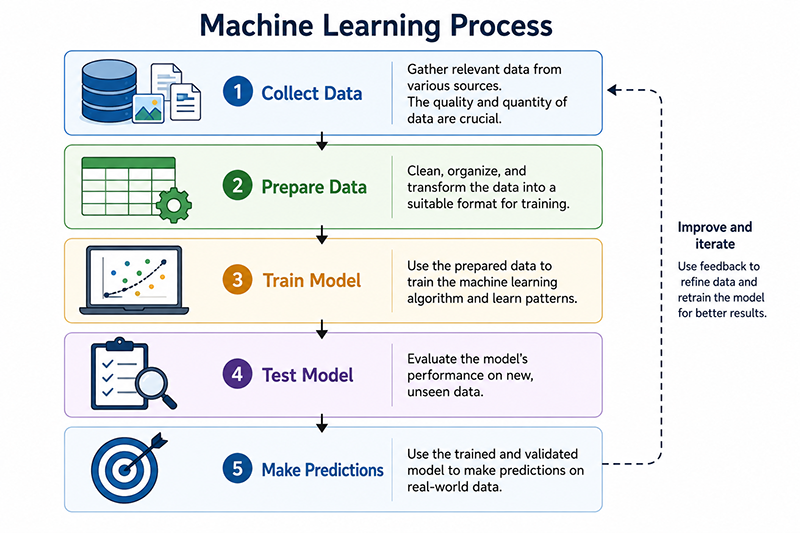
The Machine Learning process generally follows five main steps:
- Collect Data – Gather information relevant to the problem.
- Prepare the Data – Clean, organize, and format the data.
- Train the Model – Allow the computer to learn patterns from the data.
- Test the Model – Evaluate how well it performs on new, unseen data.
- Make Predictions – Use the trained model to solve real-world problems.
Although these steps appear straightforward, each one plays a critical role. Poor-quality data often leads to poor-quality predictions. This is why data scientists spend considerable time preparing and validating data before training a model.
Machine Learning models are rarely perfect after their first training session. Developers continually evaluate their performance, collect new data, retrain the model, and improve its accuracy. In many ways, the learning process resembles how humans improve a skill through practice and feedback.
Types of Machine Learning
Not all Machine Learning systems learn in the same way. Depending on the problem being solved, different learning approaches are used. The three most common types are Supervised Learning, Unsupervised Learning, and Reinforcement Learning.
Supervised Learning uses labeled examples. Each training example already contains the correct answer, allowing the computer to learn the relationship between the input and the expected output. Spam email detection, house price prediction, handwriting recognition, and medical diagnosis are all common examples of supervised learning.
Unsupervised Learning works without labeled answers. Instead of predicting a known outcome, the computer searches for hidden patterns or natural groupings within the data. Businesses often use unsupervised learning to identify different types of customers based on their purchasing behavior, while scientists use it to discover meaningful patterns in large datasets.
Reinforcement Learning takes a different approach. Instead of learning from examples, the computer learns through trial and error. It performs actions, receives rewards for good decisions and penalties for poor ones, and gradually improves its strategy over time. This method is widely used in robotics, autonomous vehicles, and AI systems that play games such as chess or Go.
Although these three approaches differ, they all share the same goal: enabling computers to improve by learning from experience rather than relying solely on predefined rules.
As AI applications become more sophisticated, some tasks require even more powerful learning methods. Recognizing objects in millions of images, understanding spoken language, or generating human-like text often demands a more advanced approach known as Deep Learning.
Conclusion
Machine Learning has become the foundation of modern Artificial Intelligence. Instead of programming computers with countless detailed instructions, developers provide examples, and the computer learns patterns from the data. This ability to learn from experience allows AI systems to improve over time and solve problems that would be extremely difficult to handle using traditional programming alone.
Understanding Machine Learning also helps explain why data is so valuable. The quality, quantity, and diversity of training data directly influence how well a model performs. As AI systems continue to evolve, Machine Learning remains one of the most important technologies driving innovation across healthcare, education, finance, transportation, manufacturing, and many other fields.
In the next article, you will explore Deep Learning, a specialized branch of Machine Learning that uses multiple layers of computation to recognize highly complex patterns.
Key Takeaways
- Machine Learning is a branch of Artificial Intelligence that enables computers to learn from data rather than relying only on programmed rules.
- A typical Machine Learning workflow includes collecting data, preparing data, training a model, testing the model, and making predictions.
- A Machine Learning model is the pattern learned from data, not the data itself.
- The three main types of Machine Learning are Supervised Learning, Unsupervised Learning, and Reinforcement Learning.
- Machine Learning powers many everyday applications, including recommendation systems, spam filtering, fraud detection, medical diagnosis, and search engines.
- The next article introduces Deep Learning, which uses multiple layers to learn more sophisticated patterns from data.