

AI Basics
Beginner
10 min read
Large Language Models (LLMs)
Learn how large language models understand and generate human language.
Introduction
In the previous articles, we built a step-by-step understanding of how modern Artificial Intelligence works. We began with What is AI?, where we learned that AI is the broad field of creating systems capable of performing tasks that normally require human intelligence.
We then explored Machine Learning, which enables computers to learn from data rather than relying solely on programmed rules. Next, we discovered how Deep Learning uses multiple layers to solve highly complex problems, and finally we examined Neural Networks, the interconnected computational structures that make Deep Learning possible.
Now we arrive at one of the most exciting developments in modern AI: Large Language Models, or LLMs.
Large Language Models are AI systems designed to understand and generate human language. They can answer questions, summarize articles, translate languages, explain difficult concepts, write computer code, draft emails, generate creative stories, and assist with countless other language-related tasks.
If you have used ChatGPT, Microsoft Copilot, Google Gemini, Claude, or similar AI assistants, then you have already interacted with an LLM.
LLMs bring together everything you have learned so far. They are built using Deep Learning, powered by Neural Networks, trained through Machine Learning, and represent one of the most advanced applications of Artificial Intelligence.
How LLMs Generate Language
At first glance, an LLM may appear to understand language just as humans do. It can answer questions, carry on conversations, write essays, explain scientific concepts, and even generate poetry. However, the way it achieves these tasks is quite different from human thinking.
Rather than memorizing complete answers, an LLM learns statistical patterns from massive collections of text. During training, it reads billions or even trillions of words from books, articles, websites, research papers, and many other sources. From this enormous amount of data, it gradually learns grammar, vocabulary, sentence structure, writing styles, relationships between ideas, and patterns of reasoning.
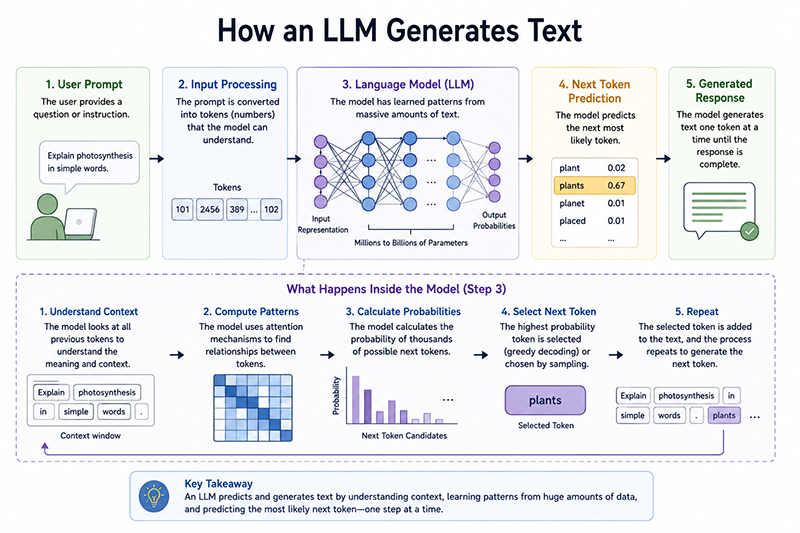
When you type a prompt, the model begins predicting what word, or more precisely what token, is most likely to come next. After predicting one token, it predicts the next, and then the next, continuing this process until it has generated a complete response.
Although this prediction happens one token at a time, it occurs extremely quickly, allowing the model to generate fluent paragraphs that often resemble human writing.
Modern LLMs are built using a neural network architecture called the Transformer. Unlike earlier neural networks, transformers can analyze relationships between many words simultaneously, allowing them to understand context much more effectively.
As you learned in Neural Networks, transformers are a specialized type of neural network. They represent one of the biggest advances in AI research and have enabled today's remarkable language models.
Applications, Strengths, and Limitations
Large Language Models are now used in education, business, healthcare, software development, customer service, research, journalism, and countless other fields.
Students use LLMs to better understand difficult topics and receive personalized explanations. Teachers use them to develop lesson plans, quizzes, and classroom activities. Businesses use them to draft reports, summarize meetings, analyze customer feedback, and improve communication. Programmers use them to generate, explain, and debug computer code.
Because LLMs understand natural language, they make AI accessible to people who have little or no programming experience. Instead of learning specialized software, users simply communicate through ordinary conversation.
However, despite their impressive capabilities, LLMs are not perfect.
This happens because an LLM is designed to generate the most likely continuation of text, not to verify facts or reason exactly as a human expert would. LLMs may also reflect bias, stereotypes, or misinformation present in their training data.
LLMs also perform best when users provide clear instructions. The quality of the response often depends on the quality of the prompt.
As LLMs continue to improve, they are becoming valuable assistants rather than replacements for human expertise. They can help people learn faster, work more efficiently, and explore ideas more creatively, but important decisions still require critical thinking, human judgment, and careful verification.
Conclusion
Large Language Models represent one of the most significant achievements in modern Artificial Intelligence. By combining advances in Machine Learning, Deep Learning, and Neural Networks, these systems have transformed the way people interact with computers.
Instead of communicating through programming languages or complex interfaces, users can now interact with AI using natural conversation.
Throughout this AI Basics learning path, you have seen how each concept builds upon the previous one. AI provides the overall goal, Machine Learning enables computers to learn from data, Deep Learning allows them to recognize highly complex patterns, Neural Networks provide the underlying architecture, and Large Language Models bring these technologies together to understand and generate human language.
This foundation prepares you to explore more advanced topics in AI. In the next category, Generative AI, you will discover how modern AI systems create entirely new text, images, audio, video, and other forms of digital content.
Key Takeaways
- Large Language Models are AI systems trained to understand and generate human language.
- LLMs are built using Deep Learning and very large Transformer Neural Networks.
- Rather than memorizing answers, LLMs generate text by predicting one token at a time.
- LLMs can answer questions, summarize information, translate languages, write code, generate content, and support learning.
- Although highly capable, LLMs can sometimes produce inaccurate information, known as hallucinations, and may reflect biases present in their training data.
- Well-written prompts with clear context and objectives usually produce better responses.