

Prompt Engineering
Intermediate
8 min read
CLEAR Framework
Learn a simple framework for writing clearer and more effective AI prompts.
Introduction
As Large Language Models (LLMs) become increasingly capable, many people assume that obtaining high-quality responses simply requires asking better questions. While there is some truth to this, experienced AI users understand that effective prompting is a structured skill rather than a matter of trial and error. A well-designed prompt provides the AI with sufficient context, a clear objective, appropriate constraints, and an understanding of the desired output.
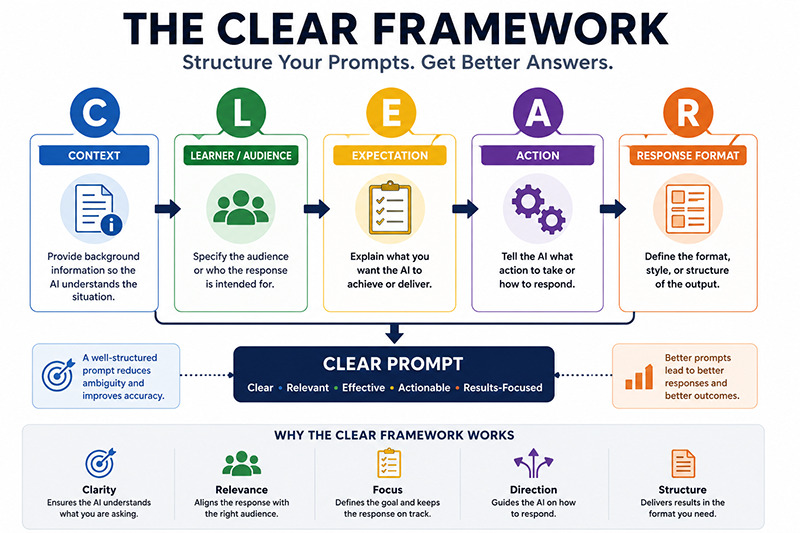
One practical approach to writing effective prompts is the CLEAR Framework. Rather than being a technical algorithm, CLEAR is a systematic method for organizing prompts so that the AI receives all the information it needs to produce useful responses.
In this article, we will use the following interpretation of the framework:
- C — Context: Provide the background information the AI needs.
- L — Limits: Define any constraints or boundaries.
- E — Expectations: Clearly state the objective or desired outcome.
- A — Audience: Specify who the response is intended for.
- R — Response Format: Explain how the output should be presented.
These five elements work together to reduce ambiguity and improve the quality, consistency, and relevance of AI-generated responses.
The CLEAR Framework serves as the foundation for many advanced prompting techniques. As you progress through this category, you will discover how Role Prompting, Few-shot Prompting, and Chain of Thought Prompting build upon these same principles to produce even more effective interactions with AI.
Understanding the CLEAR Framework
Each component of the CLEAR Framework contributes to making a prompt more precise and useful.
Context
Context tells the AI what situation it is working within. Without context, the model must make assumptions, which may lead to generic or inaccurate responses.
Immediately, the AI has a much better understanding of the task.
Limits
Limits establish boundaries for the response. These might include maximum word count, reading level, topics to avoid, available resources, time constraints, or writing style.
Limits help prevent responses that are unnecessarily long, overly technical, or unsuitable for the intended purpose.
Expectations
Expectations describe what success looks like.
The AI now understands both the scope and the objective.
Audience
The same information may need to be presented differently depending on the reader. For example, kindergarten students, undergraduate engineering students, business executives, healthcare professionals, and members of the general public all require different language and depth.
Identifying the audience helps the AI adjust its vocabulary, technical depth, and style of explanation.
Response Format
Finally, specify how the answer should be organized. Possible formats include bullet points, numbered lists, comparison tables, executive summaries, lesson plans, reports, emails, or presentations.
Clearly defining the format often saves considerable editing time after the response has been generated.
Examples from Different Professions
The value of the CLEAR Framework becomes apparent when applied to real professional tasks.
Example 1 — Teacher
The second prompt provides context, learning level, curriculum, lesson duration, expectations, audience, and response format.
Example 2 — Software Engineer
The improved prompt guides the AI toward a solution appropriate for the project's technology stack and security requirements.
Example 3 — Financial Analyst
Here, the AI understands not only what analysis is required but also who will read it and how the findings should be presented.
Example 4 — Healthcare Professional
This prompt provides clear medical context, identifies the audience, specifies the desired reading level, sets a word limit, and requests a structured format, resulting in educational content that is more useful for patients.
Example 5 — Marketing Manager
This prompt gives the AI sufficient background about the product, target audience, platform, campaign duration, key selling points, and desired output format, making the generated marketing plan significantly more actionable.
Usefulness
The CLEAR Framework provides a simple yet highly effective method for improving prompt quality across almost every domain.
First, it reduces ambiguity. AI systems perform best when tasks are clearly defined. Providing context and expectations minimizes the need for the model to guess the user's intentions.
Second, CLEAR improves consistency. When prompts follow a repeatable structure, similar tasks are more likely to produce similarly high-quality outputs.
Third, it reduces editing time. Responses generated from well-structured prompts usually require fewer revisions because the desired format, audience, and scope have already been specified.
The framework is also highly transferable. Whether someone is preparing lesson plans, writing software documentation, conducting financial analysis, or drafting business reports, the same five principles remain applicable.
Perhaps most importantly, CLEAR provides an excellent foundation for more advanced prompting techniques. As you'll see in the next article, Role Prompting extends the framework by assigning the AI a specific professional identity, allowing it to generate responses from the perspective of a teacher, lawyer, physician, software architect, or many other experts.
Limitations
Although the CLEAR Framework significantly improves prompt quality, it is not a guarantee of perfect AI responses.
First, AI models can still generate inaccurate or outdated information, particularly in specialized or rapidly changing fields. Users should always verify important facts independently.
Second, some complex tasks require multiple rounds of interaction. Even a carefully designed prompt may need refinement before achieving the desired result.
Third, excessive detail can occasionally reduce flexibility. Extremely restrictive prompts may prevent the AI from offering useful alternative ideas or creative suggestions.
Finally, different AI systems may interpret prompts differently. A prompt that performs well in one model may require minor adjustments when used with another.
Conclusion
The CLEAR Framework provides a practical foundation for effective prompt engineering by encouraging users to think systematically about what information an AI system needs before generating a response. By defining the Context, Limits, Expectations, Audience, and Response Format, users can dramatically improve the relevance, consistency, and usefulness of AI-generated content.
Rather than relying on trial and error, CLEAR transforms prompting into a structured communication process. This makes it valuable for students, educators, researchers, software developers, financial analysts, and professionals across countless industries.
In the next article, we will explore Role Prompting, where you will learn how assigning a professional identity to the AI can further improve response quality by encouraging the model to think and communicate from a specific expert perspective.
Key Takeaways
- The CLEAR Framework provides a structured approach to writing effective AI prompts.
- CLEAR stands for Context, Limits, Expectations, Audience, and Response Format.
- Well-structured prompts reduce ambiguity and improve response quality.
- The framework is applicable across education, software engineering, finance, healthcare, business, and many other professions.
- CLEAR serves as the foundation for advanced prompting techniques such as Role Prompting, Few-shot Prompting, and Chain of Thought Prompting.
- Prompt engineering is a skill that improves with practice, experimentation, and thoughtful refinement.