

The Science of AI
Beginner
8 min read
Why Model Design Matters
Discover why different AI models are designed for different tasks, how inductive biases shape learning, and why architecture plays a crucial role in the performance and capabilities of modern AI.
Introduction
Imagine asking a carpenter to repair a car engine or a mechanic to build a wooden table. Although both are highly skilled professionals, each has been trained with different tools, knowledge, and ways of solving problems.
Artificial Intelligence works in a surprisingly similar way.
Modern AI is not built around a single universal model. Instead, researchers design different architectures that are particularly well suited to different kinds of learning tasks. Some models excel at recognizing images, others process language remarkably well, while others specialize in decision-making or scientific prediction.
One of the reasons for these differences is a concept known as inductive bias. Every AI architecture contains built-in assumptions about the kinds of patterns it expects to encounter. These assumptions guide learning, making some problems easier to solve while making others more challenging.
Understanding inductive bias helps explain why model design matters—and why choosing the right architecture is often just as important as providing more data or computational power.
What Is an Inductive Bias?
Suppose someone gives you a partially completed jigsaw puzzle.
Even before finding every missing piece, you naturally make educated guesses about what the finished picture might look like. Your previous experience helps you predict how the remaining pieces should fit together.
Machine learning models behave similarly.
Rather than beginning with no expectations at all, every AI architecture incorporates certain assumptions about how information is likely to be organized. These assumptions are called inductive biases because they guide the model toward particular types of solutions during learning.
Importantly, an inductive bias is not a human prejudice or social bias. Instead, it is a design choice that influences how efficiently an AI system can recognize patterns.
Without inductive biases, learning from limited data would often become extremely difficult.
Why Memorization Is Not Enough
At first glance, memorization may seem useful. After all, remembering facts is part of human learning.However, AI models that rely too heavily on memorization often struggle when they encounter situations that differ slightly from their training examples.
Imagine an image recognition system trained only on photographs of red apples taken during daylight. If the system has merely memorized those images, it may fail to recognize a green apple, a sliced apple, or an apple photographed at night.
Generalization allows the model to recognize the concept of an apple rather than individual pictures.
This distinction explains why modern AI systems require large, diverse datasets. Exposure to varied examples helps models discover robust patterns instead of simply remembering isolated cases.
Why Different Architectures Exist
If every learning problem were identical, researchers could build a single AI architecture for every application.The real world, however, is far more diverse.
Images contain spatial relationships. Language unfolds as sequences of words. Financial markets evolve over time. Molecules form complex three-dimensional structures. These different forms of information require different ways of identifying meaningful patterns.
Researchers therefore design architectures that naturally exploit these characteristics rather than forcing every problem into the same framework.
As a result, model architecture becomes a powerful tool for improving learning efficiency and overall performance.
Examples of Architectural Design
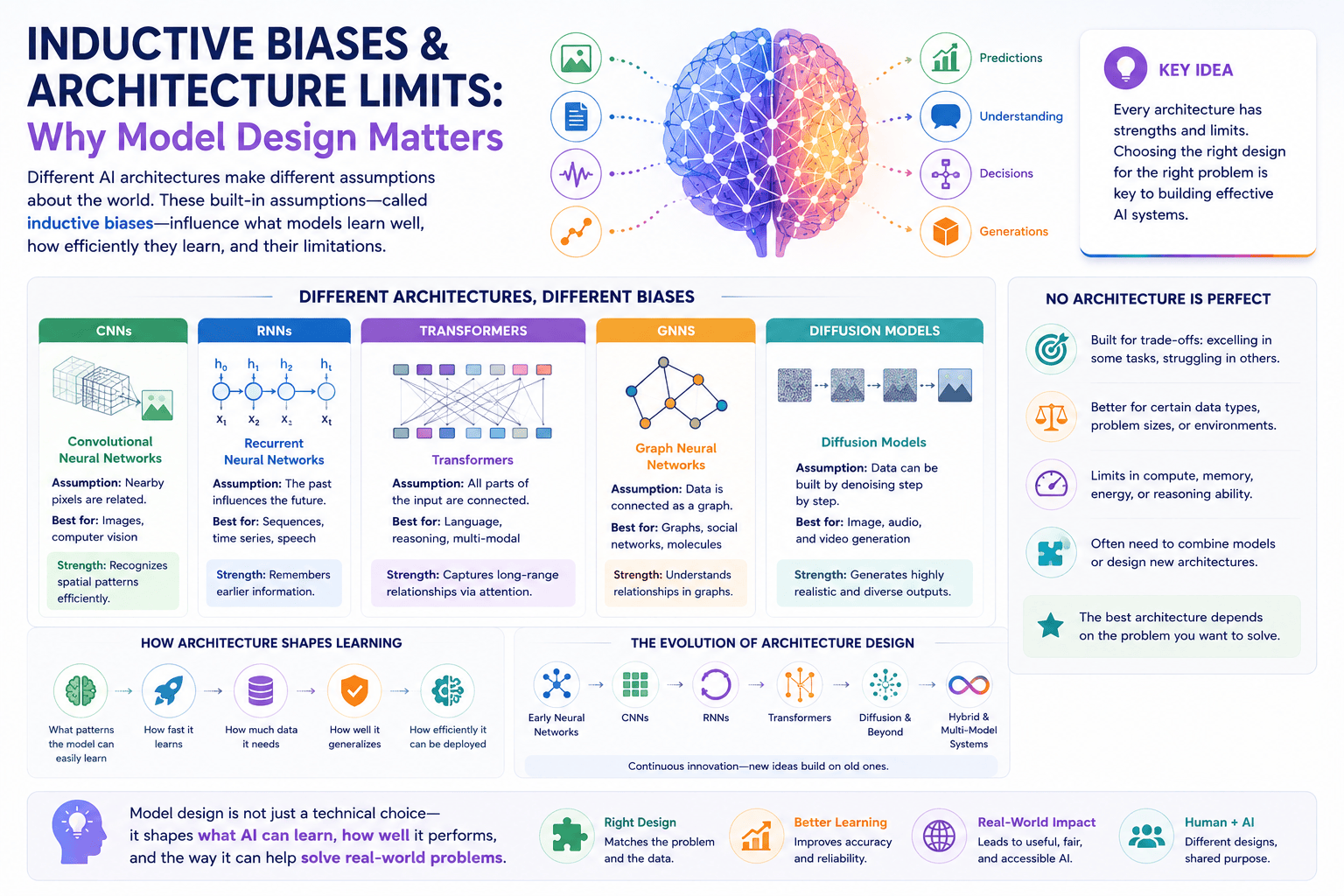
Different AI architectures incorporate different inductive biases that make them particularly effective for specific kinds of tasks.- Convolutional Neural Networks (CNNs) assume that nearby pixels are closely related, making them highly effective for image recognition and computer vision.
- Recurrent Neural Networks (RNNs) were designed to process sequential information by remembering earlier inputs, making them useful for speech and time-series analysis.
- Transformers emphasize relationships between all parts of an input simultaneously through attention mechanisms, enabling remarkable performance in language, translation, reasoning, and multimodal AI.
- Graph Neural Networks (GNNs) specialize in learning from interconnected structures such as social networks, transportation systems, and molecular interactions.
- Diffusion Models progressively learn how to generate realistic images, audio, and other media by reversing carefully controlled noise processes.
Why No Architecture Is Perfect
Every architecture represents a series of trade-offs.An architecture optimized for one problem may perform poorly when applied to a completely different task. Even today's highly successful Transformer models have limitations involving computational cost, memory requirements, reasoning consistency, and efficiency.
Similarly, architectures that excel on small datasets may struggle to scale, while extremely large models may require enormous computational resources.
These limitations remind researchers that there is no universally superior AI architecture. Instead, the most appropriate design depends on the nature of the problem being solved.
Understanding these trade-offs continues to drive innovation across machine learning research.
How Architecture Shapes Learning
Architecture influences far more than computational efficiency.The design of a model affects:
- how quickly it learns from data
- the kinds of patterns it recognizes most easily
- how much training data it requires
- how well it generalizes to unfamiliar situations
- how efficiently it can be deployed in real-world applications
Architecture Continues to Evolve
The history of Artificial Intelligence is filled with architectural innovations.Early neural networks gave way to convolutional networks, recurrent models, Transformers, diffusion models, and many newer hybrid architectures. Each generation addressed limitations discovered in earlier approaches while introducing new possibilities.
Rather than searching for a final "perfect" architecture, researchers increasingly combine ideas from multiple approaches. Modern AI systems often integrate language models, vision models, memory systems, retrieval mechanisms, planning components, and specialized reasoning modules into larger AI ecosystems.
This trend suggests that future AI may rely less on a single architecture and more on carefully designed systems of cooperating models.
Conclusion
Inductive biases help explain one of the most important ideas in machine learning: the design of an AI model shapes the way it learns.Different architectures are not simply alternative implementations of the same idea. They embody different assumptions about data, relationships, and learning itself. These assumptions enable models to solve some problems remarkably well while introducing limitations in other situations.
As AI continues to evolve, architecture design remains one of the most active areas of research. Future breakthroughs may come not only from larger models or more data, but also from discovering better ways to represent information and structure intelligent systems.
In the next article, Interpretability & Representation Engineering: Looking Inside Modern AI, we will move beyond architecture and explore an even deeper question: What happens inside a neural network while it is learning?
Key Takeaways
- Inductive biases are built-in assumptions that guide how AI models learn from data.
- Different AI architectures are designed to recognize different kinds of patterns.
- CNNs, RNNs, Transformers, Graph Neural Networks, and Diffusion Models each have unique strengths and limitations.
- No single architecture performs optimally for every learning task.
- Model architecture influences learning speed, generalization, efficiency, and real-world deployment.
- Architectural innovation remains one of the major drivers of progress in Artificial Intelligence.
- Understanding architecture helps explain why modern AI continues to evolve beyond simply building larger models.