

Future of AI
Beginner
8 min read
The Road to AGI
Discover what Artificial General Intelligence (AGI) really means, why experts disagree about its arrival, and the scientific challenges that remain on the road to general intelligence.
Introduction
Artificial Intelligence has made remarkable progress in recent years. Modern AI systems can write essays, generate software code, analyze images, summarize research papers, solve mathematical problems, and assist with countless professional tasks. These impressive capabilities have led many people to wonder whether Artificial General Intelligence (AGI) is just around the corner.Predictions about AGI often make headlines. Some researchers believe it could emerge within the next decade, while others argue that it may take many decades—or that today's AI is still fundamentally different from general intelligence.
Why do experts disagree so strongly?
One reason is that Artificial General Intelligence has no universally accepted definition. Different researchers emphasize different characteristics, making it difficult to determine exactly when an AI system should be considered "general."
Rather than focusing on speculative timelines, this article explores what AGI actually means, how it differs from today's AI systems, why researchers disagree about its arrival, and the scientific challenges that remain.
What Is Artificial General Intelligence?
Today's AI systems are remarkably capable, but they are generally designed to perform specific categories of tasks.A large language model may write reports, answer questions, generate code, and summarize documents, yet it still operates within the capabilities learned during training and inference.
Artificial General Intelligence refers to a hypothetical AI system capable of learning, reasoning, adapting, and solving problems across an extremely broad range of domains at a level comparable to—or potentially exceeding—that of humans.
An AGI would ideally be able to:
- Learn unfamiliar tasks with minimal instruction.
- Apply knowledge from one domain to another.
- Solve novel problems.
- Adapt to changing environments.
- Reason across multiple disciplines.
- Continuously improve through experience.
Rather than excelling in one category of tasks, AGI would demonstrate broad, flexible intelligence.
Narrow AI vs. General Intelligence
Every AI system in widespread use today, including advanced language models, is considered Narrow AI.As discussed throughout the AI Basics and Large Language Models (LLMs) articles, modern AI systems perform exceptionally well within specific kinds of tasks but do not possess general understanding comparable to humans. For example, a modern AI assistant may successfully:
- Write computer programs.
- Translate languages.
- Explain scientific concepts.
- Analyze charts.
- Generate images.
Why Experts Disagree
One reason AGI generates so much debate is that researchers define intelligence differently.Some believe AGI has arrived when AI performs most economically valuable work.
Others argue that true AGI requires:
- Human-level reasoning
- Common-sense understanding
- Independent learning
- Long-term planning
- Creativity Self-directed adaptation
Because no single definition is universally accepted, experts naturally reach different conclusions regarding timelines.
This explains why predictions about AGI often vary dramatically.
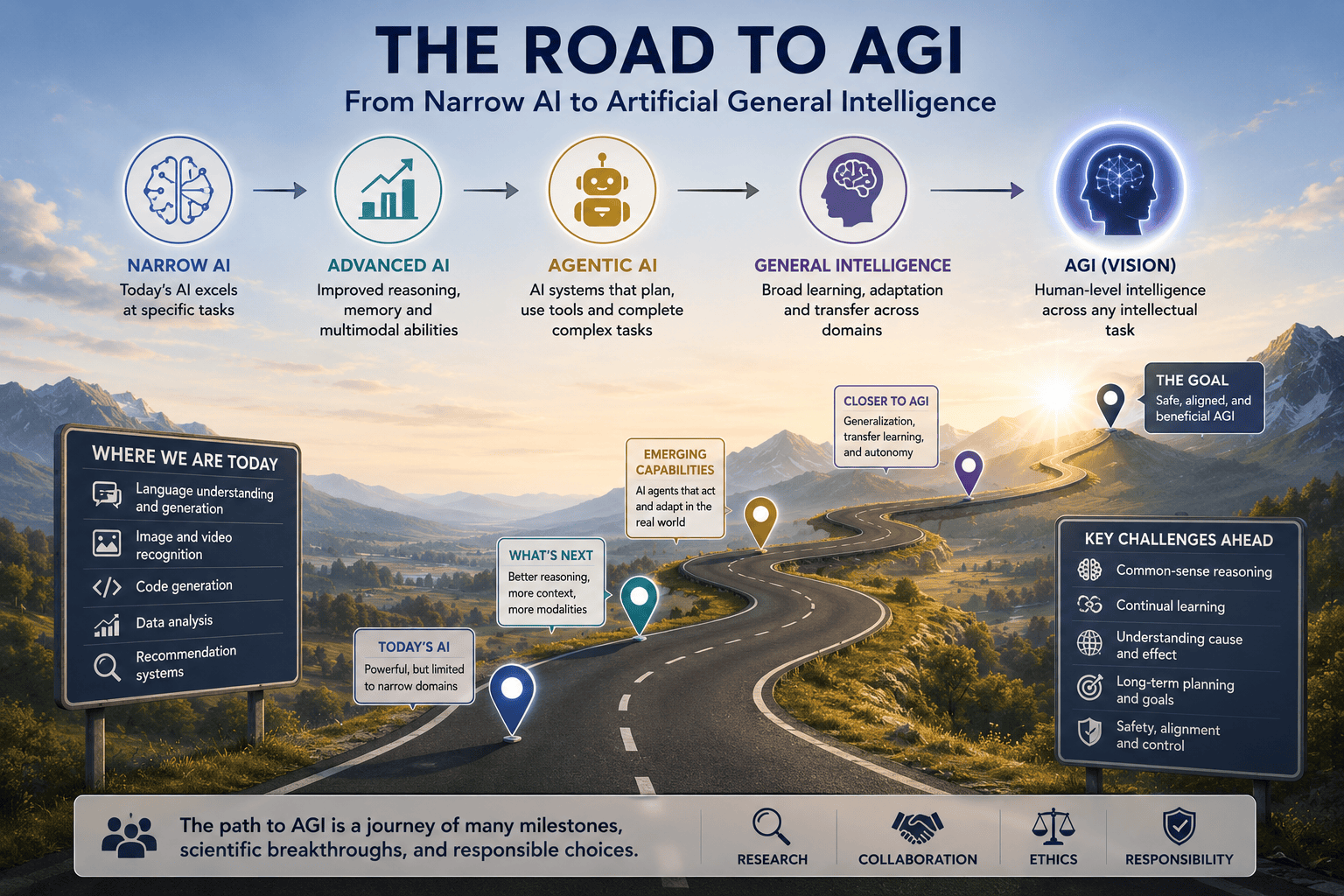
Progress Toward AGI
Although today's AI is not generally considered AGI, significant progress continues across multiple research areas.Recent advances include:
Better Reasoning
Modern AI systems increasingly solve multi-step problems more reliably than earlier generations.
Multimodal Intelligence
As discussed in Next in AI Models, AI increasingly combines text, images, audio, video, and documents within unified models.
AI Agents
Researchers are developing AI agents capable of planning, using external tools, and completing complex workflows.
Larger Context Windows
AI models can now process much larger amounts of information within a single interaction.
Improved Memory
Persistent memory allows AI assistants to remember user preferences and previous conversations when appropriate.Each of these developments moves AI toward greater flexibility, although none alone constitutes AGI.
What Challenges Remain?
Despite rapid progress, researchers continue to face major scientific challenges.
Common-Sense Reasoning
Humans effortlessly understand countless facts about everyday life that AI often struggles to infer.
Reliable Reasoning
AI still makes logical mistakes, inconsistent decisions, and factual errors in situations requiring complex reasoning.
Continual Learning
Humans learn continuously throughout life. Most AI models require retraining or carefully engineered memory systems to incorporate new knowledge effectively.
Long-Term Planning
Many real-world goals require planning over weeks, months, or years while adapting to changing circumstances. This remains an active area of AI research.
Understanding Cause and Effect
AI often recognizes statistical patterns more effectively than genuine causal relationships.Developing deeper causal reasoning remains an important research challenge.
Could AGI Transform Society?
If Artificial General Intelligence were eventually achieved, its impact could be profound.Possible applications include:
- Accelerating scientific discovery
- Supporting medical research
- Improving education
- Solving complex engineering problems
- Addressing climate and sustainability challenges
- Advancing robotics and automation
- Safety
- Alignment with human values
- Privacy
- Accountability
- Security
- Responsible governance
Challenges for the Future Workforce
The transition toward AI-enabled workplaces also presents significant challenges.Organizations must address issues such as:
- Workforce retraining
- Job displacement in some sectors
- Privacy concerns
- Data security
- Algorithmic bias
- Responsible AI governance
- Unequal access to AI technologies
Preparing people to work alongside AI is just as important as developing more advanced AI systems.
Predictions vs. Reality
Public discussions often focus on estimating when AGI will arrive.Some experts predict relatively short timelines.
Others argue that important breakthroughs remain necessary before genuinely general intelligence becomes possible.
History shows that technological forecasting is difficult.
Unexpected discoveries can accelerate progress, while seemingly simple problems sometimes require many years of additional research.
For this reason, many researchers recommend focusing less on specific dates and more on understanding the scientific challenges that remain.
Conclusion
Artificial General Intelligence remains one of the most fascinating and widely debated goals in AI research. Although today's AI systems demonstrate remarkable capabilities, they are generally regarded as highly advanced examples of Narrow AI rather than fully general intelligence.Progress toward AGI is likely to involve many interconnected advances—including better reasoning, multimodal understanding, memory, planning, continual learning, and safe collaboration with humans—rather than a single dramatic breakthrough.
Rather than asking only "When will AGI arrive?", a more useful question is "What capabilities would an AI need before we could reasonably consider it generally intelligent?"
Understanding these distinctions helps us appreciate both the extraordinary achievements of modern AI and the significant scientific challenges that still lie ahead.
In the next article, AI Regulation: Can Laws Keep Up?, we will explore how governments, international organizations, researchers, and technology companies are working to balance innovation with safety, accountability, and public trust as AI continues to evolve.
Key Takeaways
- Artificial General Intelligence (AGI) refers to AI capable of learning, reasoning, and adapting across many domains rather than excelling at specific tasks alone.
- Today's leading AI systems are highly capable Narrow AI, not universally recognized as AGI.
- Experts disagree about AGI timelines because there is no single accepted definition of general intelligence.
- Progress toward AGI includes advances in reasoning, multimodal AI, AI agents, memory, and planning.
- Significant research challenges remain, including common-sense reasoning, continual learning, causal understanding, and long-term planning.
- Responsible development and governance remain essential as AI capabilities continue to grow.
- Understanding what AGI means is more valuable than trying to predict exactly when it will arrive.