

The Science of AI
Beginner
8 min read
Looking Inside Modern AI
Discover how researchers are opening AI's "black box" to understand how neural networks represent knowledge, make decisions, and build more transparent, trustworthy, and reliable intelligent systems.
Introduction
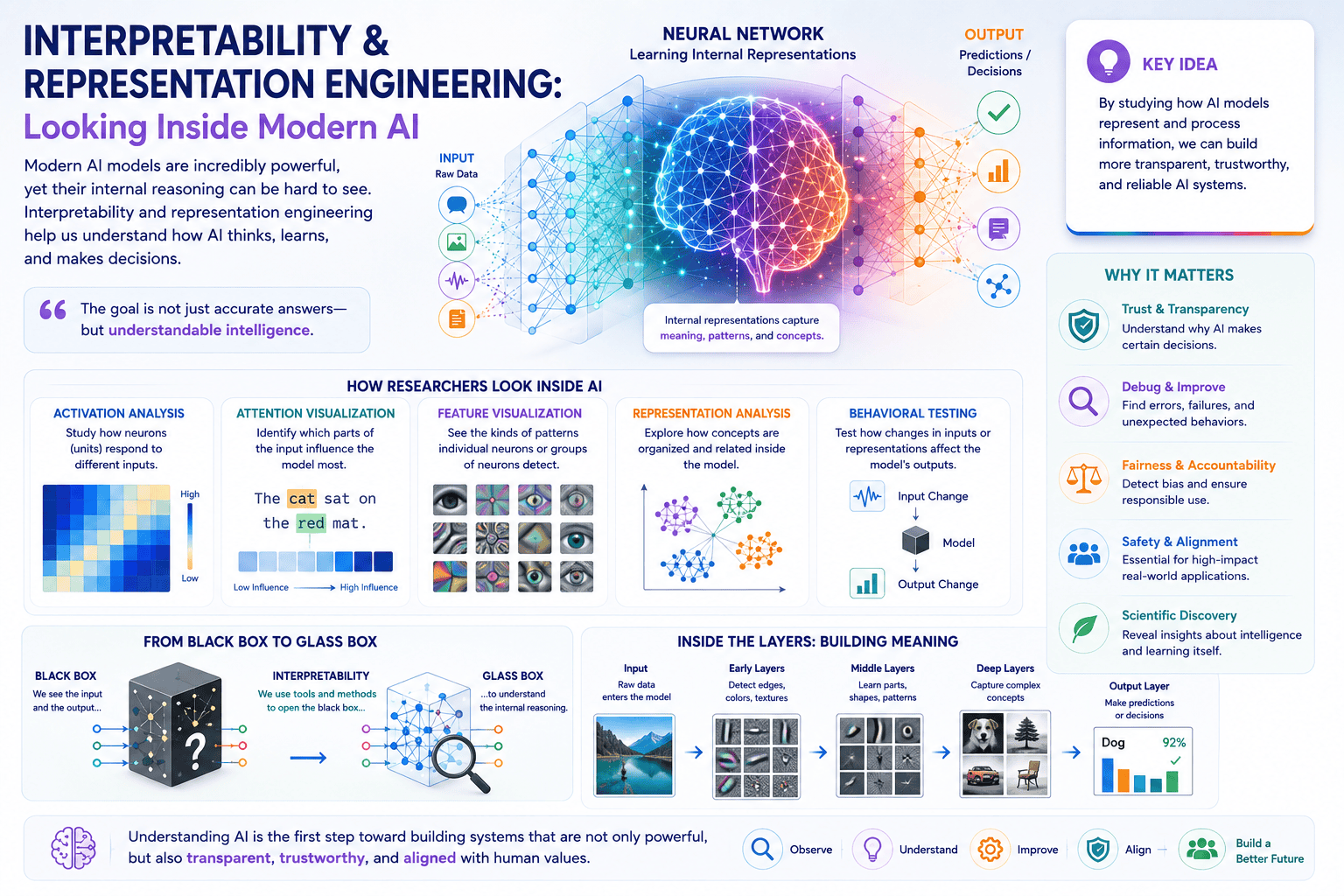
For many years, neural networks were often described as "black boxes." Researchers could observe the information entering a model and the predictions it produced, but understanding exactly how the model reached those predictions was far more difficult.
As AI systems became larger and more capable, this challenge became increasingly important. If Artificial Intelligence is used in healthcare, education, finance, scientific research, or autonomous systems, simply knowing that it produces accurate answers is no longer enough. Researchers also want to understand why it reaches those answers.
This growing field of research is known as interpretability. Closely related to it is representation engineering, an emerging area that studies how concepts are internally represented within AI models and how these representations might be analyzed—or even influenced—to improve performance, safety, and reliability.
Although these topics remain active areas of research, they are gradually transforming AI from an opaque system into one that humans can better understand and trust.
Why AI Became a Black Box
Imagine asking a mathematician to solve a difficult equation.
If they carefully explain every step, you can understand their reasoning and verify the result.
Now imagine receiving only the final answer with no explanation at all.
Even if the answer is correct, you have no way of knowing how it was obtained.
Large neural networks often behave in this second way.
Modern AI models contain millions—or even billions—of adjustable parameters interacting simultaneously. During training, these parameters gradually organize themselves into highly complex structures that humans did not design directly.
As a result, researchers often understand how models are trained, but not always how individual internal computations combine to produce specific behaviors.
This is why neural networks have traditionally been described as black boxes.
What Is Interpretability?
Interpretability focuses on making AI systems easier to understand.
Rather than treating a neural network as an unknowable object, researchers develop techniques that reveal which parts of the model contributed to particular decisions, what information influenced predictions, and how internal computations evolve during processing.
Interpretability does not necessarily simplify the model itself. Instead, it provides tools that allow humans to observe and analyze the learning process.
This work has become increasingly important as AI systems are used in situations where transparency, accountability, and human oversight are essential.
What Is Representation Engineering?
One of the most exciting discoveries in modern AI research is that neural networks appear to organize knowledge into meaningful internal representations.Instead of storing individual facts like entries in a database, AI models often develop patterns that capture broader concepts such as language, color, spatial relationships, emotions, programming syntax, or mathematical reasoning.
Representation engineering investigates these internal structures.
Rather than asking only "What answer did the model produce?", researchers ask deeper questions:
- "How is the idea of a city represented?"
- "Where is mathematical reasoning encoded?"
- "Can honesty, creativity, or multilingual ability be identified inside the network?"
How Researchers Study AI Internally
Because modern AI systems are extraordinarily complex, no single technique can explain everything happening inside them. Researchers therefore combine multiple approaches to investigate how models process information.Some of the most widely used techniques include:
- Activation analysis, which studies how different neurons respond to particular concepts or inputs.
- Attention visualization, which examines which parts of an input influence the model most strongly during processing.
- Feature visualization, which attempts to reveal the kinds of patterns individual neurons or groups of neurons have learned.
- Representation analysis, which compares how different concepts are organized within the model's internal layers.
- Behavioral testing, which explores how changing inputs or internal representations affects the model's responses.
Representation Engineering and the Future of AI
Representation engineering is still an emerging field, but many researchers believe it may become one of the most influential areas of future AI development.Instead of treating AI models as systems that can only be trained from scratch, representation engineering explores whether internal concepts can be understood, refined, or carefully guided after training.
Although this research is still developing, it raises fascinating possibilities.
Future AI systems may become easier to interpret, safer to deploy, more transparent, and better aligned with human intentions because researchers understand their internal representations more deeply.
Rather than simply observing AI behavior from the outside, scientists are gradually learning to study intelligence from within.
Conclusion
Interpretability and representation engineering represent an important shift in Artificial Intelligence research.Rather than focusing solely on improving model performance, researchers increasingly seek to understand how AI systems organize knowledge, process information, and generate decisions.
Although modern neural networks remain extraordinarily complex, every new discovery brings scientists closer to explaining the internal mechanisms behind intelligent behavior.
This deeper understanding will play a vital role in developing AI systems that are not only more capable, but also more transparent, trustworthy, and aligned with human values.
In the next article, Alignment Theory & Goal Misgeneralization: Teaching AI the Right Objectives, we will examine another crucial challenge: How can we ensure that increasingly capable AI systems pursue the goals we actually intend?
Key Takeaways
- Interpretability seeks to explain how AI systems arrive at their decisions.
- Representation engineering studies how concepts and knowledge are internally organized within neural networks.
- Modern AI models are often described as black boxes because of their enormous complexity.
- Researchers use techniques such as activation analysis, attention visualization, feature visualization, and representation analysis to investigate internal model behavior.
- Better interpretability improves transparency, debugging, fairness, safety, and human trust.
- Representation engineering is an emerging field that may help researchers better understand, guide, and improve future AI systems.
- Understanding what happens inside neural networks is becoming one of the most exciting frontiers in Artificial Intelligence research.