

The Science of AI
Beginner
8 min read
How AI Learns Beyond Memorization
Discover how AI learns underlying patterns instead of merely memorizing examples—and how the loss landscape guides models toward better predictions on new, unseen data.
Introduction
Imagine studying for an exam by memorizing the answers to every practice question without understanding the underlying concepts. You might perform well if the exam contains identical questions, but struggle as soon as something unfamiliar appears.Artificial Intelligence faces a similar challenge.
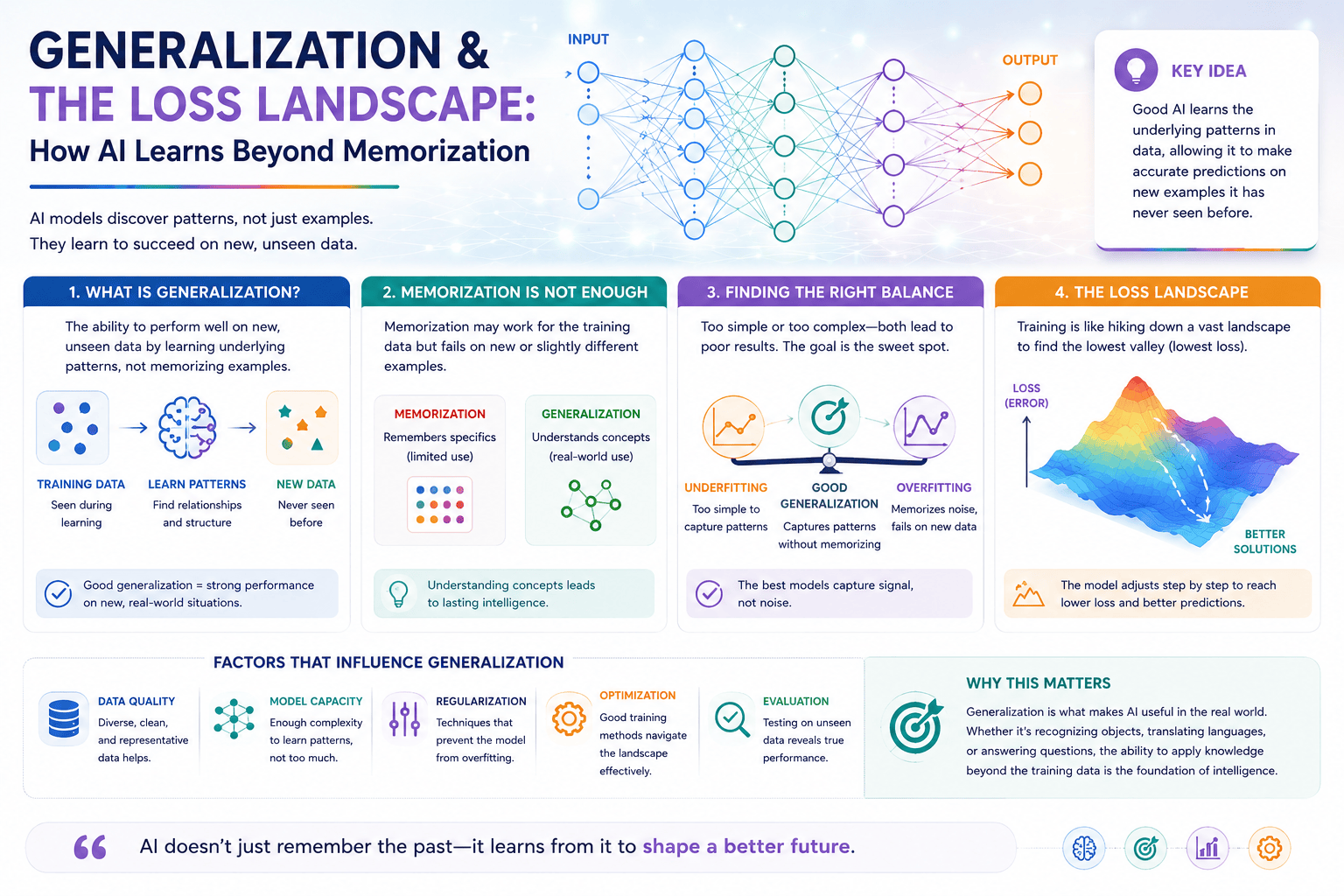
An AI model that simply memorizes its training data would have little practical value. The true goal of machine learning is generalization, or the ability to recognize patterns during training and apply that knowledge to new situations the model has never encountered before.
Closely connected to this idea is the concept of the loss landscape, which researchers use to understand how AI models gradually improve during training. Although the term sounds highly mathematical, the underlying idea is surprisingly intuitive. It helps explain how AI moves from making poor predictions to discovering increasingly accurate solutions.
Together, generalization and the loss landscape provide a deeper understanding of how modern AI learns—and why successful learning involves far more than memorization.
What Is Generalization?
Consider teaching a child to recognize dogs.Rather than memorizing thousands of individual dogs, the child gradually learns common characteristics such as ears, tails, fur, body shape, and movement. Eventually, the child can correctly identify a dog they have never seen before.
Machine learning aims to achieve something similar.
During training, an AI model examines countless examples and adjusts itself to identify underlying relationships within the data. If training is successful, the model develops a set of internal representations that allow it to respond appropriately when presented with completely new examples.
Whether identifying images, translating languages, predicting stock trends, or answering questions, the goal remains the same: perform well on data that was never part of the training process.
Generalization is therefore one of the defining characteristics of intelligent behavior.
Why Memorization Is Not Enough
At first glance, memorization may seem useful. After all, remembering facts is part of human learning.However, AI models that rely too heavily on memorization often struggle when they encounter situations that differ slightly from their training examples.
Imagine an image recognition system trained only on photographs of red apples taken during daylight. If the system has merely memorized those images, it may fail to recognize a green apple, a sliced apple, or an apple photographed at night.
Generalization allows the model to recognize the concept of an apple rather than individual pictures.
This distinction explains why modern AI systems require large, diverse datasets. Exposure to varied examples helps models discover robust patterns instead of simply remembering isolated cases.
Overfitting and Underfitting
Researchers often describe learning using two common problems that lie at opposite ends of a spectrum:Underfitting occurs when a model is too simple to capture important patterns within the data, resulting in poor performance on both familiar and unfamiliar examples.
- Overfitting occurs when a model learns the training data too precisely, including accidental noise and random variations that do not represent genuine patterns.
- Good generalization lies between these extremes, where the model captures meaningful relationships without memorizing unnecessary details.
-
Finding this balance is one of the central challenges in machine learning research.
What Is the Loss Landscape?
The phrase loss landscape may sound intimidating, but the idea can be understood through a simple analogy.Imagine standing somewhere in a vast mountain range.
Your goal is to reach the lowest valley.
Every step downhill brings you closer to the best possible destination, while climbing uphill moves you farther away.
Training an AI model works in a remarkably similar way.
During learning, the model repeatedly makes predictions and measures how wrong those predictions are. This measure of error is called the loss.
Researchers visualize all possible model configurations as an enormous landscape filled with hills, valleys, ridges, and plateaus. The learning algorithm continually adjusts the model's parameters, searching for lower regions where prediction errors become smaller.
Rather than finding a perfect solution immediately, training is a gradual process of moving through this landscape toward increasingly accurate solutions.
Why the Landscape Matters
The shape of the loss landscape strongly influences how efficiently an AI model can learn.Some regions contain steep slopes that allow rapid improvement, while others contain flat plateaus where progress slows considerably. Certain valleys represent solutions that perform well only on training data, whereas broader valleys often correspond to models that generalize better to unseen examples.
Researchers therefore study the geometry of the loss landscape to better understand why some training methods produce models that are more stable, reliable, and adaptable than others.
Although modern AI models contain billions of parameters, the underlying goal remains surprisingly simple: find solutions that minimize prediction errors while preserving the ability to generalize.
Why Generalization Remains an Active Research Area
Despite tremendous advances in AI, researchers still do not fully understand why very large neural networks often generalize so well.Classical statistical theory suggested that extremely large models might simply memorize their training data. Yet modern foundation models frequently demonstrate impressive performance on entirely new tasks.
Researchers continue investigating questions such as:
- Why do large neural networks often avoid harmful overfitting?
- How do training data, model architecture, and optimization interact to improve generalization?
- Why do some solutions in the loss landscape lead to more reliable performance than others?
- Can we design training methods that improve both accuracy and robustness?
These questions remain among the most active areas of machine learning research today.
Conclusion
Generalization lies at the heart of modern Artificial Intelligence. Rather than memorizing individual examples, successful AI systems learn patterns that allow them to make useful predictions in unfamiliar situations.The concept of the loss landscape helps researchers understand how this learning process unfolds. By gradually reducing prediction errors and navigating increasingly better solutions, AI models develop the ability to solve problems that extend far beyond the examples used during training.
Although much remains to be discovered about why large neural networks generalize so effectively, these ideas continue to shape the development of more capable, reliable, and trustworthy AI systems.
In the next article, Inductive Biases & Architecture Limits: Why Model Design Matters, we will explore another fascinating question: Why do different AI architectures learn different kinds of problems so well?
Key Takeaways
- Generalization is the ability of an AI model to perform well on new data rather than simply memorizing its training examples.
- Effective machine learning depends on recognizing underlying patterns instead of remembering individual cases.
- Underfitting occurs when a model is too simple, while overfitting occurs when it memorizes the training data too closely.
- The loss landscape is a conceptual way of visualizing how AI models improve by gradually reducing prediction errors during training.
- Different regions of the loss landscape influence how well models learn and how effectively they generalize.
- Researchers continue studying why today's very large AI models generalize so successfully despite their enormous complexity.
- Generalization remains one of the most important—and least completely understood—foundations of modern Artificial Intelligence.