

AI Basics
Beginner
8 min read
Neural Networks
Explore the interconnected computational structures that make modern deep learning possible.
Introduction
In the previous article, Deep Learning, we discovered that Deep Learning enables computers to recognize highly complex patterns by learning through many layers. But what exactly are these layers made of? The answer lies in Neural Networks, the computational structures that form the foundation of modern Deep Learning.
Despite their name, artificial neural networks are not miniature human brains. They are mathematical models inspired by the way neurons in the human brain communicate with one another. Just as biological neurons pass signals to neighboring neurons, artificial neural networks pass information between interconnected nodes, allowing computers to gradually learn patterns from data.
Neural networks have become one of the most important technologies in Artificial Intelligence. They power systems that recognize faces, understand speech, translate languages, recommend products, diagnose diseases, and even generate entirely new text and images.
Earlier, What is AI? introduced the broad field of Artificial Intelligence, Machine Learning explained how computers learn from data, and Deep Learning showed how learning through many layers enables more advanced AI. In this article, you will look inside those layers and see how they actually work.
How Neural Networks Learn
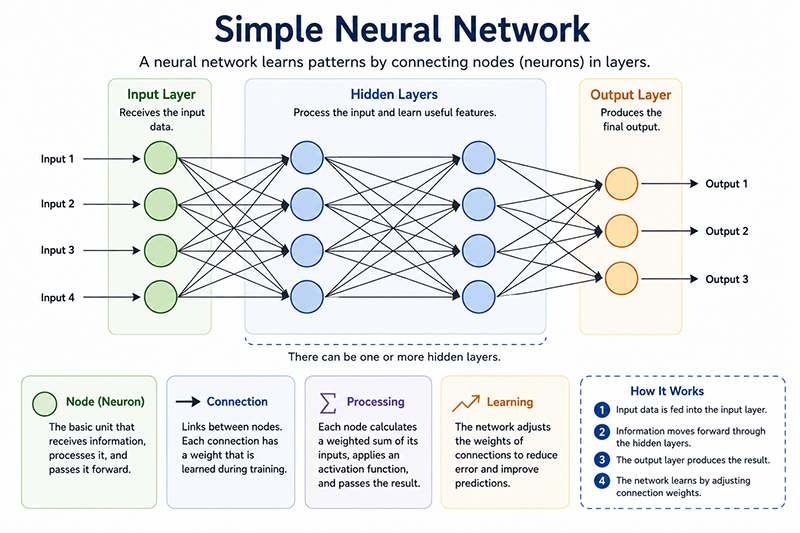
A neural network is made up of many small processing units called nodes, often referred to as artificial neurons. These nodes are organized into layers that work together to transform input data into useful predictions or decisions.
Most neural networks contain three main types of layers:
- Input Layer – receives the raw data.
- Hidden Layer or Layers – process and transform the information.
- Output Layer – produces the final prediction or result.
Suppose a neural network is trained to recognize handwritten numbers. The input layer receives information about the pixels in the image. The hidden layers gradually identify increasingly meaningful features, such as lines, curves, loops, and shapes. Finally, the output layer predicts whether the image represents a 3, 7, 9, or another digit.
The learning occurs by adjusting the strength of the connections between nodes. Every connection has a numerical value called a weight. During training, the network makes predictions, compares them with the correct answers, calculates its errors, and then adjusts these weights to improve future predictions.
This learning process happens millions, or even billions, of times when training today's largest AI models. Although each individual adjustment is tiny, together they enable neural networks to recognize incredibly complex patterns that would be almost impossible to program manually.
From Neural Networks to Modern AI
As researchers developed larger and more sophisticated neural networks, they discovered that different network architectures perform better for different kinds of problems.
Convolutional Neural Networks, or CNNs, are particularly effective for analyzing images because they specialize in recognizing visual patterns such as edges, textures, and objects. Recurrent Neural Networks, or RNNs, were developed to process sequences of information such as speech and text, where the order of information matters.
More recently, a newer architecture called the Transformer has revolutionized Artificial Intelligence. Unlike earlier neural networks, transformers can analyze relationships between many pieces of information simultaneously, making them exceptionally good at understanding language.
Neural networks are now used in countless real-world applications. They help doctors analyze medical images, enable autonomous vehicles to recognize roads and pedestrians, improve weather forecasting, recommend movies and products, detect financial fraud, generate realistic images, compose music, and assist scientists in discovering new medicines.
Despite these impressive capabilities, neural networks also have limitations. Large networks often require enormous amounts of data and computing power to train effectively. Their internal decision-making processes can also be difficult to interpret, making it challenging to explain exactly why a particular prediction was made.
Perhaps the most exciting application of neural networks today is the development of Large Language Models. These systems use extremely large transformer-based neural networks to understand and generate human language.
Conclusion
Neural networks provide the foundation upon which modern Deep Learning is built. By organizing artificial neurons into interconnected layers and continuously adjusting the strengths of their connections, these networks learn to recognize increasingly complex patterns from data.
From recognizing faces and understanding speech to generating images and answering questions, neural networks have transformed what computers can accomplish. They connect all of the concepts you have learned so far, linking Machine Learning with Deep Learning and preparing the way for today's most advanced AI systems.
In the next article, you will explore Large Language Models, where you will see how enormous transformer-based neural networks enable AI systems like ChatGPT to understand, generate, summarize, translate, and explain human language.
Key Takeaways
- Neural networks are the computational structures that power modern Deep Learning.
- A neural network consists of an input layer, one or more hidden layers, and an output layer.
- Networks learn by adjusting the weights of the connections between nodes to reduce prediction errors.
- Neural networks automatically discover useful features in data, making them highly effective for complex tasks.
- Different architectures, such as CNNs, RNNs, and Transformers, are designed for different types of problems.
- Large Language Models are built using enormous transformer-based neural networks that can understand and generate human language.