

Future of AI
Beginner
8 min read
How AI Is Changing Careers
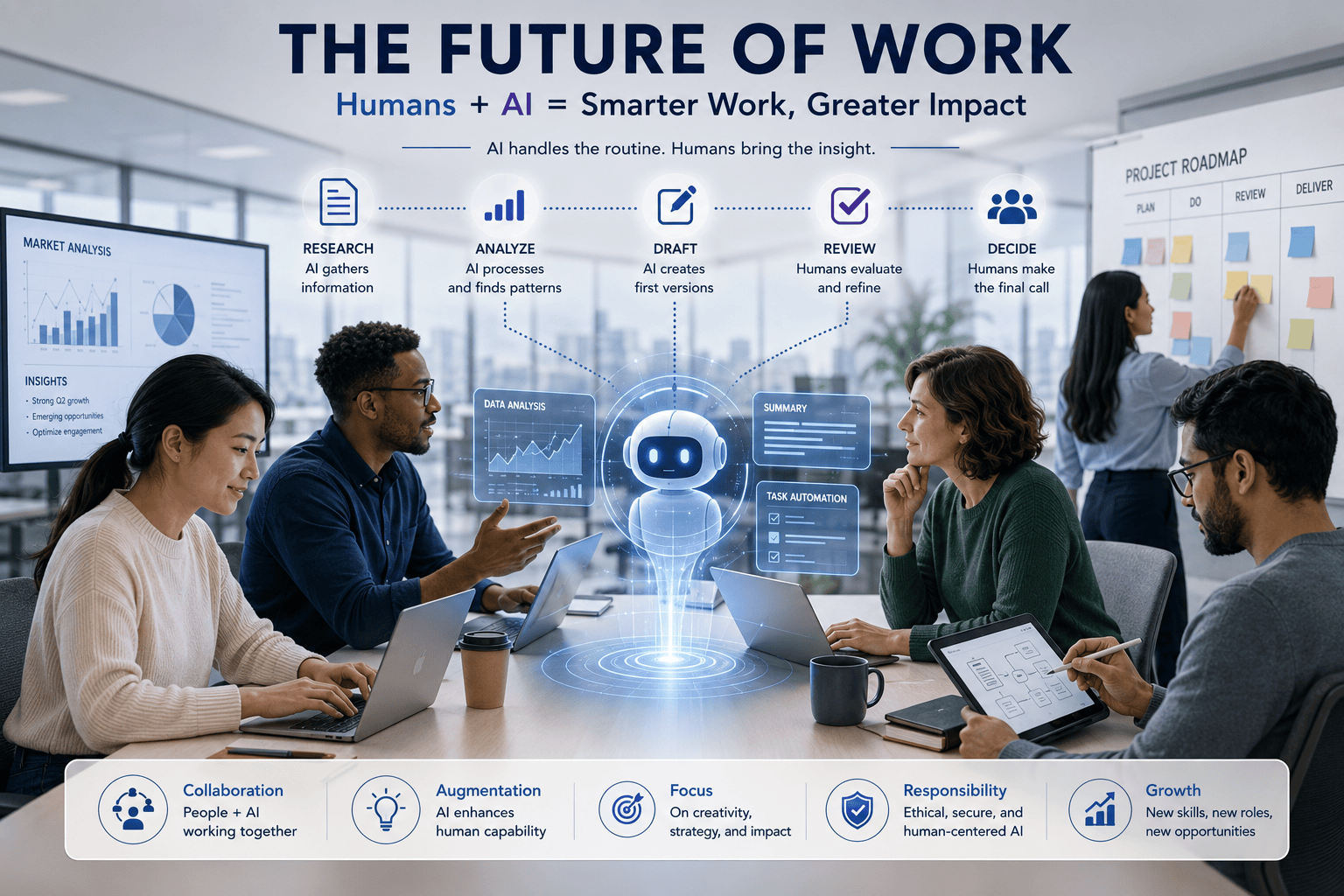
The Future Workplace Combines Human Expertise with Artificial Intelligence, Allowing People to Focus on Creativity, Decision-Making, and Meaningful Collaboration While AI Automates Routine Tasks.
Introduction
Artificial Intelligence is rapidly becoming part of everyday work. From drafting emails and summarizing meetings to analyzing data, generating software code, creating marketing content, and supporting medical research, AI tools are changing how people perform many professional tasks.These changes have led to an important question:
Will AI replace human workers?
The answer is more nuanced than a simple yes or no.
Throughout history, technological innovations have changed the nature of work rather than eliminating the need for people altogether. The Industrial Revolution transformed manufacturing, computers reshaped office work, and the internet created entirely new industries. Artificial Intelligence represents the next major technological transformation.
Rather than replacing every profession, AI is increasingly automating routine tasks, augmenting human capabilities, and creating new opportunities for collaboration between people and intelligent systems.
Understanding this shift is essential for students, professionals, organizations, and policymakers preparing for the future.
AI Is Transforming Tasks More Than Jobs
One of the biggest misconceptions about AI is that entire occupations disappear overnight.In reality, most professions consist of many different tasks.
For example, a teacher may:
- Plan lessons
- Explain concepts
- Assess student progress
- Provide encouragement
- Communicate with parents
- Organize classroom activities
- Prepare learning materials
Others—including mentoring students, managing classroom dynamics, and building relationships—continue to depend heavily on human expertise.
The same pattern appears across healthcare, finance, engineering, law, journalism, research, and many other fields.
AI is therefore more likely to automate specific tasks than entire professions.
This means many jobs will evolve rather than disappear.
Human Skills Remain Essential
Modern AI excels at processing information, recognizing patterns, generating content, and performing repetitive analytical work.Humans continue to possess strengths that remain difficult for AI to replicate consistently, including:
- Critical thinking
- Ethical judgment
- Creativity
- Emotional intelligence
- Leadership
- Negotiation
- Empathy
- Complex decision-making
- Cultural understanding
Similarly, AI may assist architects with design ideas, but understanding a client's vision, community needs, and aesthetic preferences still requires human insight. These uniquely human capabilities are becoming even more valuable as AI handles routine work.
Human-AI Collaboration
Instead of viewing AI as a replacement for human workers, many organizations are adopting a collaborative model.As discussed in Human-in-the-Loop AI, AI performs analysis, generates recommendations, and automates repetitive tasks, while humans provide oversight, contextual understanding, ethical judgment, and final decision-making.
For example:
- Doctors review AI-assisted diagnoses.
- Financial analysts evaluate AI-generated forecasts.
- Engineers verify AI-generated software code.
- Teachers adapt AI-created lesson plans for individual learners.
- Researchers validate AI-assisted literature reviews.
-
In these situations, AI functions as a highly capable assistant rather than an independent decision-maker.
The goal is not to remove humans from the process but to allow people to focus on higher-value work.
New Careers Are Emerging
Every major technological transformation creates new professions.Artificial Intelligence is no exception.
Examples of emerging AI-related careers include:
- AI Product Manager
- Prompt Engineer
- AI Trainer
- AI Safety Researcher
- Responsible AI Specialist
- AI Auditor
- AI Policy Advisor
- Machine Learning Engineer
- AI Integration Consultant
For example, marketers increasingly use AI for content generation, accountants automate routine reporting, architects explore AI-assisted design, and scientists accelerate research using intelligent tools.
Rather than replacing expertise, AI is becoming another professional capability.
AI Literacy Is Becoming a Core Skill
Just as computer literacy became essential over the past several decades, AI literacy is becoming increasingly important across industries.AI literacy includes understanding:
- What AI can do well
- Its limitations
- Responsible use
- Verification of AI-generated information
- Ethical considerations
- Effective collaboration with AI
As explored throughout the Prompt Engineering category, well-designed prompts provide context, define objectives, specify constraints, and guide AI toward more useful responses.
Prompt engineering is therefore less about learning special commands and more about developing clear communication and problem-solving skills. These abilities are likely to benefit professionals in many different fields.
Lifelong Learning Will Become More Important
Because AI technologies continue to evolve rapidly, learning can no longer end after formal education.Professionals increasingly benefit from continuously updating their knowledge and skills throughout their careers.
This does not necessarily mean becoming an AI researcher.
Instead, it means developing adaptability and remaining open to learning new tools as they emerge.
Future professionals may periodically learn:
- New AI software
- Updated workplace technologies
- Emerging regulations
- Industry-specific AI applications
- New methods of collaboration
Adaptability itself is becoming one of the most valuable career skills.
Challenges for the Future Workforce
The transition toward AI-enabled workplaces also presents significant challenges.Organizations must address issues such as:
- Workforce retraining
- Job displacement in some sectors
- Privacy concerns
- Data security
- Algorithmic bias
- Responsible AI governance
- Unequal access to AI technologies
Preparing people to work alongside AI is just as important as developing more advanced AI systems.
Preparing for an AI-Augmented Future
The most successful professionals of the future are unlikely to be those who compete against AI.Instead, they will be those who understand how to collaborate with it effectively.
This means learning when to:
- Delegate routine work to AI.
- Verify AI-generated outputs.
- Apply critical thinking.
- Make ethical decisions.
- Combine human expertise with machine capabilities.
Conclusion
Artificial Intelligence is transforming the workplace, but its greatest impact is likely to come from changing how work is performed, not simply replacing workers.As AI automates routine tasks, human expertise becomes increasingly focused on creativity, communication, ethical judgment, leadership, and complex decision-making. Organizations that successfully combine human intelligence with AI capabilities are likely to achieve the greatest benefits while maintaining accountability and public trust.
Preparing for this future requires more than learning new software. It requires developing AI literacy, embracing lifelong learning, and understanding how to collaborate effectively with intelligent systems.
The future of work belongs not to humans or AI alone, but to people who know how to work alongside AI responsibly and effectively.
In the next article, The Road to AGI: How Close Are We, Really?, we will explore one of the most widely discussed questions in artificial intelligence: what Artificial General Intelligence (AGI) actually means, why experts disagree about its arrival, and why understanding the concept is more important than predicting a date.
Key Takeaways
- AI is transforming tasks more rapidly than entire professions.
- Human strengths such as creativity, empathy, ethical judgment, and leadership remain essential in an AI-enabled workplace.
- Human-AI collaboration, as explored in Human-in-the-Loop AI, is becoming a common model across many industries.
- AI literacy, including the ability to communicate effectively through Prompt Engineering, is becoming a valuable professional skill.
- New careers are emerging alongside AI, while existing professions are evolving rather than disappearing.
- Lifelong learning and adaptability will help professionals remain effective as AI technologies continue to advance.
- The future of work is best understood as a partnership between human expertise and artificial intelligence rather than a competition between the two.