

Future of AI
Beginner
8 min read
Skills for the Next Decade
Discover the skills that will help you thrive in an AI-enabled future, from critical thinking and creativity to AI literacy, ethics, adaptability, and lifelong learning.
Introduction
Artificial Intelligence is becoming part of everyday life. Whether we realize it or not, AI already helps recommend what we watch, filters spam from our email, assists doctors in diagnosing diseases, supports scientific research, generates software code, powers customer service, and helps students learn more efficiently.As AI continues to improve, an important question emerges:
How can people thrive in a world where intelligent systems become increasingly capable?
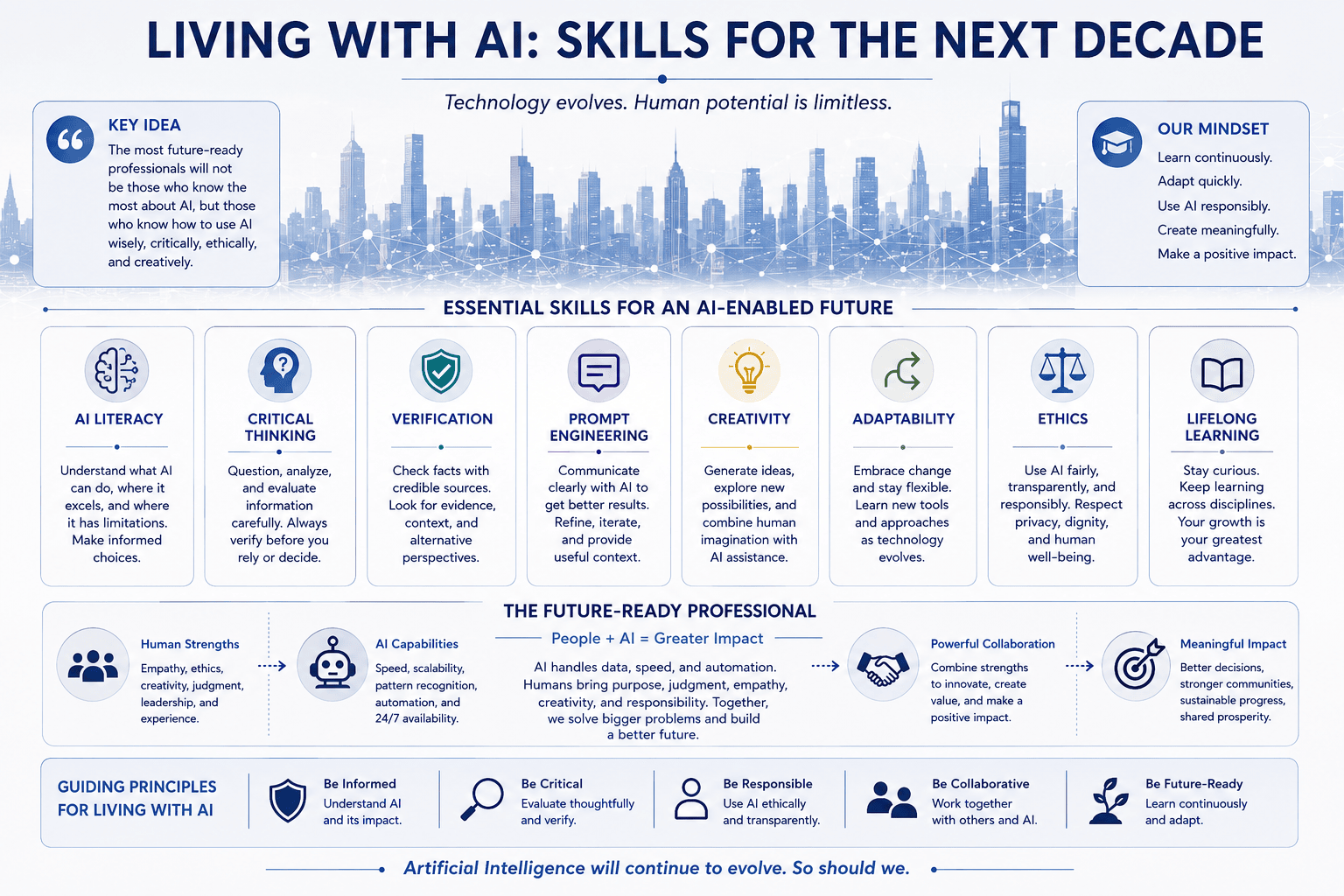
The answer is not simply learning how to use the latest AI tools. Technology changes rapidly, and today's most popular AI systems will eventually be replaced by newer ones. The skills that remain valuable are those that allow people to understand AI, think critically about its outputs, collaborate with it effectively, and continue learning throughout their lives.
Rather than competing against AI, the future belongs to people who understand how to combine human strengths with intelligent technologies.
AI Literacy: Understanding the Technology
Just as digital literacy became an essential skill during the internet age, AI literacy is becoming an important foundation for education and professional life.AI literacy does not require everyone to become a machine learning engineer or computer scientist. Instead, it means developing a practical understanding of what AI can do, where it performs well, where it struggles, and how it should be used responsibly.
People who understand AI are better equipped to choose appropriate tools, recognize unrealistic claims, protect their privacy, and make informed decisions about when AI should—and should not—be used.
Throughout this LearnerBox curriculum, we have explored many of these foundational ideas, from AI Basics and Large Language Models (LLMs) to Generative AI, Prompt Engineering, and AI Ethics. Together, they form the foundation of AI literacy.
Human Skills Become More Valuable
Ironically, as AI becomes increasingly capable, many uniquely human abilities become even more important.AI can process enormous amounts of information in seconds, but it cannot replace the full range of human judgment, empathy, cultural understanding, creativity, or ethical reasoning.
Future-ready professionals will increasingly rely on a combination of technical understanding and human-centered skills.
These include:
- AI literacy and responsible use
- Critical thinking and verification
- Effective prompt engineering and communication
- Creativity and innovation
- Adaptability and continuous learning
- Ethical decision-making
- Collaboration and teamwork
- Emotional intelligence and leadership
Think Critically, Not Automatically
One of the most important habits in an AI-enabled world is critical thinking.Modern AI systems generate remarkably convincing responses, yet they can still make factual mistakes, misunderstand context, or produce information that sounds plausible without being accurate.
As discussed in Prompt Engineering, effective prompts often improve AI outputs. However, even well-written prompts do not eliminate the need for human verification.
Future professionals should therefore develop the habit of asking:
- Is this information supported by reliable evidence?
- Does it make logical sense?
- Can it be verified using trusted sources?
- Are there alternative interpretations?
Rather than accepting AI outputs uncritically, successful professionals will treat AI as an intelligent assistant whose work should be reviewed thoughtfully.
Creativity in an Age of AI
Some people worry that AI will reduce the importance of human creativity.In practice, the opposite often occurs.
By automating repetitive tasks such as drafting documents, generating initial designs, or organizing information, AI can free people to spend more time exploring ideas, solving complex problems, experimenting with new approaches, and communicating more effectively.
Creative thinking remains deeply human because it involves imagination, curiosity, lived experience, emotional understanding, and the ability to connect ideas across different domains.
AI can generate possibilities.
Humans decide which possibilities matter.
Adaptability Is the New Competitive Advantage
One certainty about Artificial Intelligence is that it will continue to evolve.New models, applications, and workplace tools appear regularly, making it impossible to master every technology that emerges.
Instead of trying to memorize every new AI platform, professionals benefit more from developing adaptability.
Adaptable learners remain curious, embrace change, evaluate new technologies thoughtfully, and continuously improve their knowledge as circumstances evolve.
This mindset often proves more valuable than expertise in any single software application because technologies change far more quickly than fundamental learning skills.
Ethics and Responsibility Remain Human Responsibilities
Throughout this curriculum we have emphasized that AI should support human decision-making rather than replace human responsibility.Whether designing AI systems, using AI in education, deploying AI in healthcare, or making business decisions, ethical judgment ultimately remains a human responsibility.
As explored in Human-in-the-Loop AI, Responsible AI Governance, and AI Regulation, people remain accountable for ensuring that AI is used fairly, transparently, responsibly, and in ways that respect privacy, human dignity, and public trust.
Technology may become increasingly intelligent, but wisdom remains a distinctly human quality.
Lifelong Learning in an AI World
Perhaps the most important skill for the next decade is a willingness to continue learning.Previous generations adapted to personal computers, the internet, smartphones, and cloud computing. Today's learners are adapting to Artificial Intelligence.
Future generations will undoubtedly encounter technologies that we cannot yet predict.
People who embrace lifelong learning are better prepared for these changes because they view learning as an ongoing process rather than something completed after formal education.
In an AI-enabled world, curiosity may become one of the most valuable professional qualities of all.
Conclusion
Artificial Intelligence will undoubtedly continue transforming the way we learn, work, create, and solve problems. Yet the future will not be defined by technology alone.It will be shaped by how people choose to use that technology.
The professionals who thrive over the next decade are unlikely to be those who simply use AI most frequently. Instead, they will be those who combine AI literacy with critical thinking, creativity, ethical judgment, adaptability, and a commitment to lifelong learning.
Throughout this LearnerBox curriculum, we have explored how AI works, how to communicate with it effectively, how to use it responsibly, and where it may be heading. These topics are not separate disciplines but interconnected parts of becoming an informed and responsible participant in an increasingly AI-enabled world.
Artificial Intelligence will continue to evolve.
So should we.
Key Takeaways
- AI literacy is becoming as important as digital literacy in the modern workplace.
- Critical thinking and verification remain essential because AI outputs should always be evaluated thoughtfully.
- Prompt engineering and effective communication help people collaborate more successfully with AI systems.
- Creativity, empathy, ethical reasoning, and leadership are likely to become even more valuable as AI automates routine tasks.
- Adaptability and lifelong learning are among the most important skills for thriving in a rapidly changing technological landscape.
- Humans remain responsible for ensuring AI is used ethically, fairly, transparently, and responsibly.
- The future belongs not to humans or AI alone, but to people who know how to combine the strengths of both.