

Future of AI
Beginner
8 min read
How AI Is Evolving
Discover how today's AI models are evolving into multimodal, reasoning, and agentic systems that will shape the next generation of intelligent assistants.
Introduction
Artificial Intelligence has advanced at an extraordinary pace over the past few years. Large Language Models (LLMs) that once specialized in generating text can now understand images, analyze documents, write software, summarize meetings, and assist with increasingly complex tasks. Models such as Claude, Gemini, and other modern AI systems demonstrate capabilities that were considered ambitious research goals only a few years ago.
Yet today's AI models are not the final destination. Researchers and technology companies continue to improve how AI systems reason, remember information, understand multiple forms of data, and collaborate with humans. These developments suggest that future AI models will become more capable, more efficient, and better integrated into everyday work and life.
Importantly, this evolution is not about making AI "smarter" in a single step. Instead, it involves gradual improvements across many areas, including reasoning, memory, multimodal understanding, personalization, and autonomous task execution.
This article explores several of the most significant directions in which AI models are evolving. Rather than making speculative predictions, it focuses on developments that are already visible today and are likely to shape AI over the next several years.
From Language Models to General AI Assistants
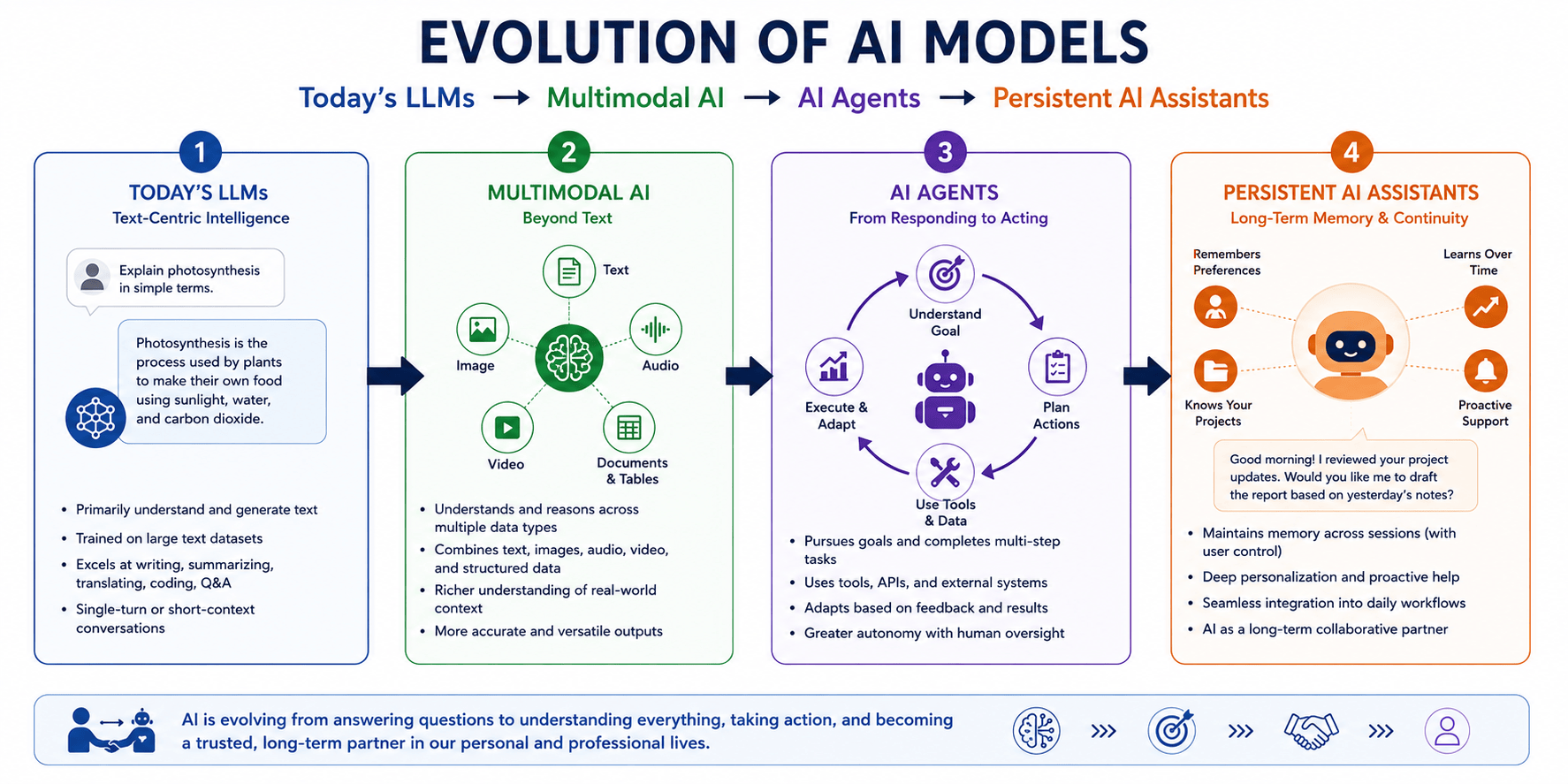
The first generation of modern AI systems primarily focused on generating and understanding text.As discussed in Large Language Models (LLMs), these models learned statistical relationships within massive collections of text, allowing them to answer questions, write essays, summarize documents, and generate computer code.
Today's leading AI systems are expanding far beyond language alone.
Rather than functioning simply as chatbots, they are becoming general-purpose AI assistants capable of working across multiple types of information and supporting increasingly complex workflows.
Instead of asking AI isolated questions, users increasingly collaborate with AI throughout larger projects by combining conversation, document analysis, programming, research, planning, and creative work within a single interaction.
This shift represents one of the most significant changes in modern AI development.
Multimodal AI
One of the clearest trends in AI is the move toward multimodal intelligence.Traditional language models processed only text. Modern AI systems increasingly understand multiple forms of information, including:
- Text
- Images
- Audio
- Video
- Tables
- Charts
- Documents
- Computer interfaces
Rather than treating each type of data separately, future AI models will increasingly combine information from multiple sources to develop richer contextual understanding.
This allows AI to solve problems that cannot be addressed through text alone.
Better Reasoning
Another major area of development is reasoning.Earlier AI models often produced fluent answers without carefully analyzing complex problems. While they could generate convincing text, they sometimes struggled with multi-step reasoning or logical consistency.
Modern AI systems increasingly devote computational effort to reasoning before generating responses.
Rather than immediately predicting the next word, they evaluate relationships between ideas, break problems into smaller components, and consider multiple possible solutions before responding.
This improvement has significant implications for scientific research, mathematics, programming, engineering, legal analysis, and strategic planning.
As discussed in Chain of Thought Prompting, encouraging structured reasoning through effective prompts can already improve AI performance. Future AI models are expected to strengthen these reasoning capabilities even further through advances in model architecture and training techniques.
Rather than replacing human reasoning, these improvements allow AI to become a more capable partner in solving complex problems.
AI Agents
Today's AI typically responds when users ask questions.The next generation of AI is increasingly moving toward AI agents.
An AI agent is designed to pursue broader goals by carrying out multiple related tasks with limited human guidance.
For example, instead of asking an AI to summarize one document, a future AI agent might:
- Search for relevant information.
- Compare multiple sources.
- Generate a report.
- Create presentation slides.
- Schedule follow-up tasks.
- Revise outputs based on feedback.
Rather than replacing human decision-making, AI agents are expected to automate repetitive workflows while leaving strategic decisions under human control.
This evolution is likely to transform how individuals and organizations interact with AI.
Longer Context and Better Memory
One limitation of earlier AI systems was their restricted memory during conversations.Recent AI models have dramatically expanded their context windows, allowing them to process much larger amounts of information within a single interaction.
Instead of analyzing only a few pages of text, modern systems can now work with lengthy reports, books, research papers, software projects, or large collections of documents.
Future models are also expected to improve persistent memory, allowing AI to remember user preferences, previous projects, and long-term objectives when appropriate and with user permission.
This capability supports more natural collaboration between humans and AI.
Rather than restarting every conversation from the beginning, AI assistants may increasingly build upon previous interactions while respecting privacy and user control.
Smaller, Faster, and More Efficient Models
Although large AI models continue to grow in capability, researchers are also developing smaller models that perform specialized tasks more efficiently.These models require less computing power while still achieving excellent performance within specific domains.
For businesses, this means AI can increasingly operate:
- On laptops
- On smartphones
- On industrial equipment
- Within medical devices
- At the edge of networks
This trend makes AI more accessible across a wider range of applications.
Personalized AI
Future AI models are also becoming increasingly personalized.Rather than treating every interaction as completely independent, AI assistants may gradually adapt to individual users by learning:
- Preferred writing styles
- Frequently used terminology
- Professional interests
- Project goals
- Communication preferences
Personalization enables AI to provide more relevant assistance without requiring users to repeat the same instructions in every conversation.
As explored throughout the Prompt Engineering category, providing clear context and objectives already improves AI performance. Future models may reduce this effort by remembering appropriate contextual information across interactions while maintaining user privacy and control.
Challenges Ahead
Although AI models continue to improve rapidly, several important challenges remain.Researchers continue working to reduce hallucinations, improve factual accuracy, strengthen reasoning, and make AI systems more transparent and explainable.
As AI capabilities increase, Responsible AI principles become even more important.
Questions involving fairness, privacy, accountability, security, and human oversight remain central to the future of AI development.
Technological progress must therefore be accompanied by equally thoughtful advances in ethics, governance, and public trust.
Conclusion
The future of AI models is being shaped through continuous improvements rather than a single revolutionary breakthrough. Advances in multimodal understanding, reasoning, AI agents, memory, personalization, and efficient model design are steadily transforming AI from a conversational tool into a collaborative partner capable of supporting increasingly complex human activities.Importantly, these developments are already underway. Many of the capabilities discussed in this article are emerging in today's leading AI systems and will likely become more widespread over the coming years.
Understanding these trends helps individuals and organizations prepare not only for more capable AI, but also for new ways of working alongside intelligent systems.
In the next article, we will explore AI and the Future of Work, examining how these technological advances are reshaping careers, creating new opportunities, and changing the skills that will become most valuable in the years ahead.
Key Takeaways
- AI models are evolving from text-based systems into multimodal intelligent assistants capable of understanding many forms of information.
- Improvements in reasoning are enabling AI to solve increasingly complex problems with greater reliability.
- AI agents represent a shift from answering individual questions to completing multi-step tasks toward broader goals.
- Larger context windows and persistent memory are making AI collaboration more natural and productive.
- Smaller, specialized models are expanding AI beyond cloud computing to local devices and industry-specific applications.
- Personalization is allowing AI assistants to adapt to individual users while emphasizing privacy and user control.
- The future of AI depends not only on technical innovation but also on responsible development, ethical governance, and human collaboration.