

Generative AI
Intermediate
10 min read
DeepSeek
Explore how DeepSeek advances efficient, open-weight AI models through innovative architectures and powerful reasoning capabilities.
Introduction
The rapid growth of Large Language Models has been driven by remarkable advances in computing power, massive datasets, and increasingly sophisticated neural network architectures. For several years, the most capable AI systems were developed primarily by a small number of large technology companies with access to enormous computational resources. This led many observers to believe that only organizations with vast financial investments could build state-of-the-art AI models.
The emergence of DeepSeek challenged that assumption.
Developed by DeepSeek AI, a Chinese artificial intelligence company founded in 2023, DeepSeek quickly attracted international attention by demonstrating that highly capable language models could be developed using innovative training techniques and efficient model architectures. Rather than simply competing on model size, DeepSeek emphasized computational efficiency, reasoning ability, and open-weight model releases that allowed researchers and organizations to study, deploy, and adapt the models for their own applications.
Like ChatGPT, Claude, Gemini, and Copilot, DeepSeek is built upon transformer-based Large Language Models introduced earlier in this learning journey. However, its growing influence comes not only from its performance but also from its contribution to the expanding ecosystem of open-weight AI models, which provide greater transparency and flexibility than many proprietary systems.
DeepSeek has become an important case study in how competition, open research, and architectural innovation continue to accelerate progress in Artificial Intelligence. Its development illustrates that the future of AI will likely be shaped by multiple research communities rather than a small number of technology companies alone.
Efficient Models and Advanced Reasoning
One of DeepSeek's defining characteristics is its emphasis on efficient model design.
For many years, AI progress was often measured by increasing the number of model parameters. Larger models generally produced stronger performance but required enormous computational resources for both training and deployment. DeepSeek demonstrated that carefully designed architectures could achieve competitive performance while using computational resources more efficiently.
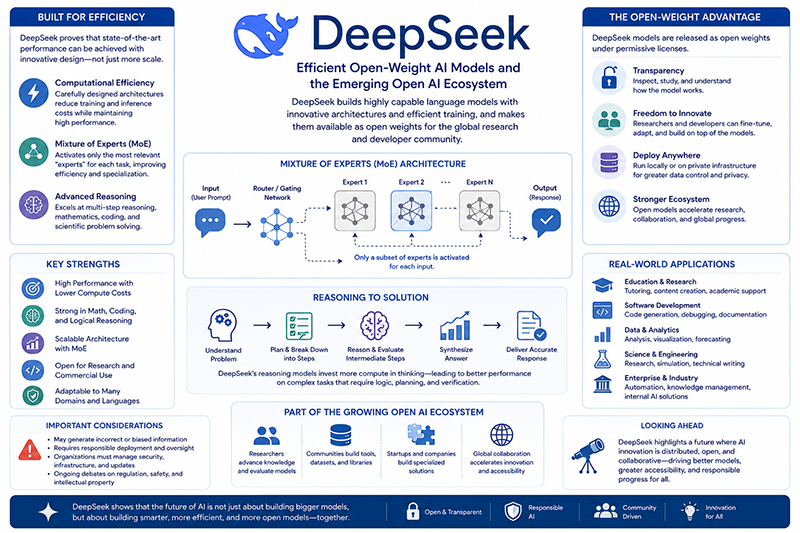
A major contributor to this efficiency is the use of Mixture of Experts (MoE) architectures in several DeepSeek models.
Traditional neural networks activate nearly all of their parameters for every request. In contrast, a Mixture of Experts model contains multiple specialized sub-networks, known as experts. For any given task, only a small subset of these experts is activated. This allows the model to maintain very large overall capacity while significantly reducing the amount of computation required for each inference.
In simple terms, rather than asking every expert to solve every problem, the model learns which specialists are most relevant for a particular task.
This architecture provides two important advantages. First, it improves computational efficiency by reducing unnecessary calculations. Second, it allows different experts to develop strengths in different domains, such as mathematics, programming, language understanding, or logical reasoning.
DeepSeek has also received considerable attention for its reasoning-oriented models. Rather than focusing solely on fluent text generation, these models were designed to perform well on tasks requiring multi-step logical reasoning, mathematical problem solving, software development, and scientific analysis.
Modern reasoning models often spend additional computational effort evaluating intermediate steps before producing a final answer. This allows them to solve more complex problems than earlier language models that relied primarily on direct next-token prediction.
Although reasoning capabilities continue to evolve across all major AI systems—including ChatGPT, Claude, and Gemini—DeepSeek has played an important role in demonstrating that strong reasoning performance can be achieved through careful architectural design rather than simply increasing model size.
Another important aspect of DeepSeek's development is its contribution to the open-weight AI ecosystem.
An open-weight model makes its trained parameters available for researchers, developers, and organizations to download and deploy under specified licensing terms. This differs from many commercial AI services, where users interact with models only through cloud-based APIs without access to the underlying model weights.
Open-weight models encourage academic research, independent evaluation, model customization, and local deployment, allowing organizations to adapt AI systems for specialized domains while maintaining greater control over privacy and infrastructure.
Open AI Ecosystem, Applications, and Future Directions
DeepSeek has become increasingly popular among researchers, universities, startups, and organizations interested in building their own AI applications. Because many DeepSeek models are available as open weights, developers can deploy them on private servers, fine-tune them using domain-specific datasets, or integrate them into specialized software without relying entirely on external cloud services.
This flexibility is particularly valuable for organizations handling sensitive information, including healthcare providers, financial institutions, research laboratories, and government agencies, where data privacy and regulatory compliance may limit the use of externally hosted AI services.
DeepSeek has also become an important benchmark for AI research. Researchers frequently compare new language models against DeepSeek on tasks involving mathematics, logical reasoning, programming, multilingual understanding, and scientific problem solving. Such benchmark comparisons help the research community evaluate progress while identifying areas where models continue to struggle.
Like every Large Language Model discussed throughout this category, DeepSeek has important limitations.
Although its reasoning capabilities are impressive, it can still generate incorrect information, misunderstand ambiguous questions, or produce responses influenced by biases present in its training data. Open-weight availability also introduces additional responsibilities. Organizations deploying their own models must manage security, updates, infrastructure, and responsible AI governance themselves rather than relying entirely on a commercial provider.
Furthermore, the growing availability of increasingly capable open-weight models raises important questions regarding AI regulation, intellectual property, safety, and international collaboration. Policymakers, researchers, and industry leaders continue to debate how advanced AI should be governed while encouraging innovation and scientific progress.
The emergence of DeepSeek illustrates an important trend in Artificial Intelligence: innovation is becoming increasingly distributed across the global research community. Progress now comes not only from larger companies with extensive computational resources but also from organizations that introduce novel architectures, efficient training strategies, and open scientific collaboration.
As future AI systems become more capable, the distinction between proprietary and open AI ecosystems may become one of the defining themes shaping research, education, business, and public policy.
Conclusion
DeepSeek represents an important milestone in the continuing evolution of Large Language Models. By emphasizing computational efficiency, advanced reasoning, Mixture of Experts architectures, and open-weight model releases, DeepSeek demonstrated that state-of-the-art AI can be achieved through architectural innovation as well as scale.
Throughout this category, you have explored five influential AI assistants, each representing a different philosophy for developing modern Artificial Intelligence. ChatGPT introduced conversational AI to a global audience through instruction tuning and Reinforcement Learning from Human Feedback. Claude emphasized Constitutional AI, long-context reasoning, and safety. Gemini demonstrated the potential of native multimodal intelligence integrated across Google's ecosystem. Copilot embedded AI directly into professional productivity and software development workflows. Finally, DeepSeek highlighted the importance of efficient architectures and the growing role of open-weight AI models in expanding access to advanced Artificial Intelligence.
Together, these systems illustrate that there is no single path toward building intelligent machines. Instead, modern AI continues to evolve through diverse research approaches, competing design philosophies, and global collaboration. Understanding these different approaches provides a strong foundation for exploring the next generation of Generative AI technologies and the broader future of Artificial Intelligence.
Key Takeaways
- DeepSeek is a family of Large Language Models developed by DeepSeek AI, emphasizing efficient architectures and advanced reasoning.
- Several DeepSeek models use Mixture of Experts (MoE) architectures, activating only relevant portions of the network to improve computational efficiency.
- DeepSeek has gained recognition for strong performance in mathematics, programming, logical reasoning, and scientific problem solving.
- Its open-weight model releases have contributed significantly to AI research, education, and enterprise deployment by enabling greater transparency and customization.
- Like all Large Language Models, DeepSeek can still generate incorrect information and requires careful human oversight.
- DeepSeek demonstrates that innovation in AI depends not only on larger models but also on efficient design, open research, and architectural advances.
- Together with ChatGPT, Claude, Gemini, and Copilot, DeepSeek illustrates the diverse approaches currently shaping the future of Generative Artificial Intelligence.