

The Science of AI
Beginner
8 min read
Why Information Drives Intelligence
Discover how Information Theory provides the mathematical foundation for machine learning, revealing how AI reduces uncertainty, compresses knowledge, and transforms data into accurate predictions.
Introduction
Artificial Intelligence is often described as a system that learns from data. But what exactly is data? More importantly, what makes one piece of data more useful than another? Why can some observations dramatically improve a model's predictions while others add almost no new knowledge?
These questions lead to one of the deepest ideas in computer science: Information Theory.
Developed by Claude Shannon in 1948, Information Theory was originally intended to study communication over noisy channels. Surprisingly, many of its fundamental concepts now lie at the heart of modern Machine Learning. Every time an AI model learns from examples, predicts the next word in a sentence, compresses information, or reduces uncertainty, it is applying ideas that Information Theory helps explain.
Unlike earlier articles in this series, this topic introduces a small amount of mathematics. Fortunately, the mathematics is not difficult to appreciate once the underlying intuition is understood. The goal is not to derive formulas, but to understand why information, not simply data, is the true currency of intelligence.
Information Is About Reducing Uncertainty
Suppose someone tells you:
This simple example illustrates one of Shannon's most important insights: information is not measured by the length of a message but by how much uncertainty it removes.
Machine learning operates in much the same way. An AI model constantly receives observations that help it become less uncertain about future predictions. During training, every useful example slightly reduces uncertainty about the underlying relationships hidden within the data.
Information, therefore, is not simply stored knowledge. It is knowledge that changes what the model believes about the world.
Measuring Information
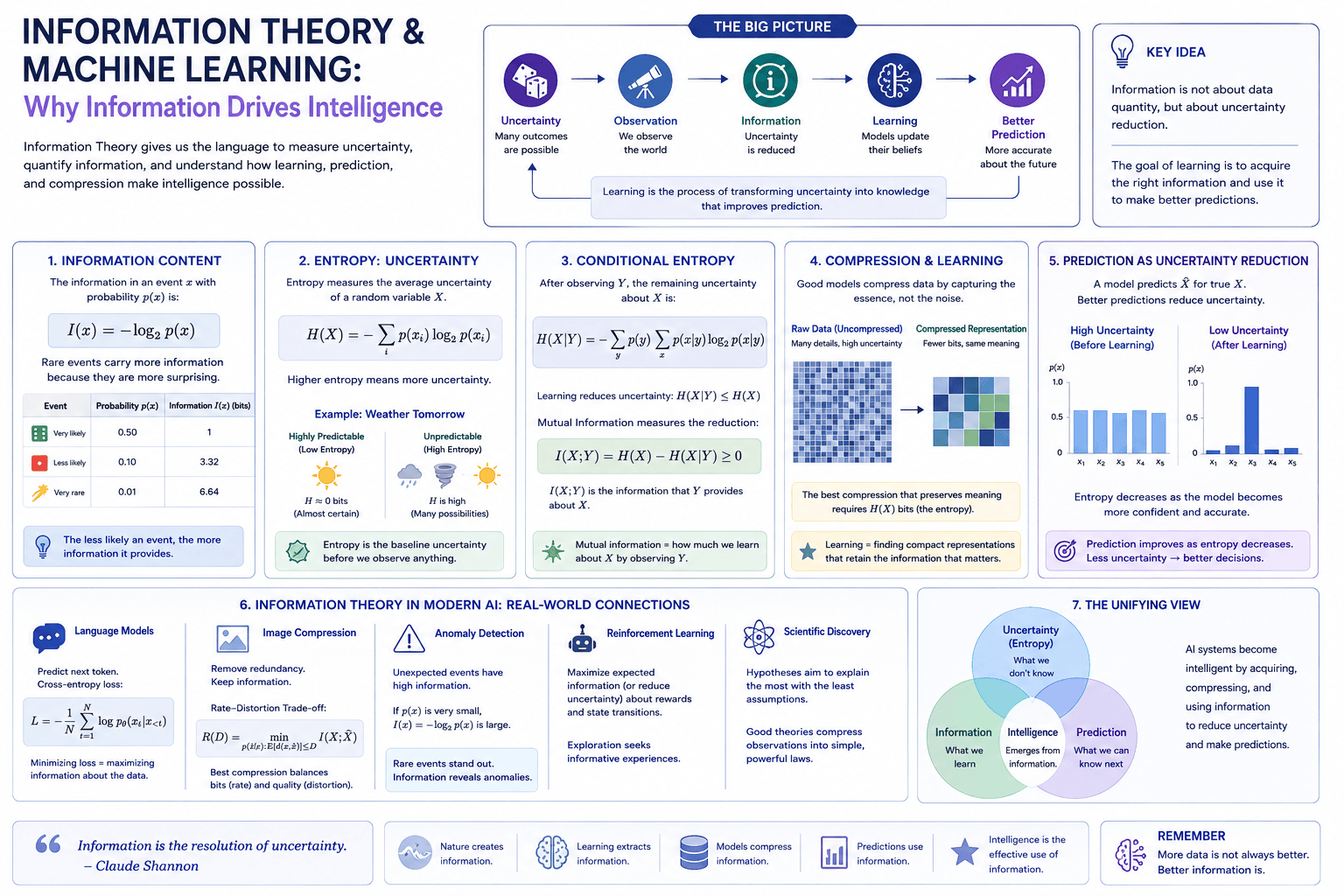
Shannon showed that information could be measured mathematically. If an event occurs with probability p, its information content is \[ I(x) = -\log_{2} p(x) \] This equation captures an intuitive idea.Common events carry relatively little information because they are expected. Rare events carry much more information because they surprise us.
For example, if you flip a fair coin, neither Heads nor Tails is surprising because each occurs with probability 0.5. However, drawing a particular card from a well-shuffled deck or observing an extremely rare astronomical event provides considerably more information because those outcomes are much less likely.
Machine learning systems continually update their internal understanding by incorporating observations whose information content helps reduce uncertainty.
Entropy: Measuring Uncertainty
If information measures the surprise of a single event, entropy measures the average uncertainty of an entire system.Shannon defined entropy as \[ H(X) = -\sum_{i} p(x_i)\log_{2} p(x_i) \] Although the equation appears complicated, the intuition is remarkably simple.
Imagine trying to guess tomorrow's weather. If you live somewhere with almost identical weather every day, your uncertainty is relatively low. If you live somewhere with highly unpredictable weather, your uncertainty is much greater.
Entropy measures exactly this kind of uncertainty.
High entropy means many outcomes are plausible and prediction is difficult. Low entropy means the system is relatively predictable.
Machine learning can therefore be viewed as a process of transforming high uncertainty into lower uncertainty through observation and learning.
Why Compression and Learning Are Closely Related
One of the most surprising ideas in Information Theory is the close relationship between compression and learning.Imagine reading an entire novel.
A person who truly understands the story can usually summarize it accurately using only a few paragraphs. Someone who does not understand it may need to repeat almost every sentence.
Learning works similarly.
An effective machine learning model discovers compact internal representations that capture the important patterns within data while ignoring unnecessary detail. Instead of memorizing every training example, the model compresses the underlying structure into its parameters.
This idea explains why modern AI can generate entirely new text, recognize unfamiliar images, or solve problems it has never explicitly encountered. The model has learned a compressed representation of the patterns that generated the data rather than storing every individual observation.
Researchers sometimes describe intelligence itself as a highly efficient form of compression: discovering simple internal structures that explain complex external observations.
Prediction Is the Ultimate Test of Learning
Ultimately, the success of any machine learning model depends on prediction.When an AI system predicts the next word, classifies an image, recommends a product, or forecasts tomorrow's weather, it is estimating which outcome is most likely given the information it has already observed.
Information Theory helps explain why accurate prediction becomes possible.
Every observation reduces uncertainty about future events. As uncertainty decreases, prediction improves. Learning therefore becomes a continuous cycle of observation, uncertainty reduction, prediction, evaluation, and refinement.
Modern Large Language Models provide an excellent example of this principle. Although they appear to understand language in a human-like way, one of their fundamental training objectives is remarkably simple: predicting the next token given the previous context. Yet through billions of such prediction tasks, highly sophisticated language capabilities gradually emerge.
Information Theory in Modern AI
Today, Information Theory influences nearly every area of Artificial Intelligence.Loss functions used during training often measure differences between predicted and observed probability distributions. Language models estimate uncertainty while generating text. Image compression, speech recognition, recommendation systems, anomaly detection, reinforcement learning, and scientific data analysis all rely, directly or indirectly, on information-theoretic principles.
Even concepts discussed earlier in this series—generalization, representation learning, interpretability, and alignment—are closely connected to how efficiently AI systems acquire, organize, and utilize information.
Rather than being an isolated mathematical theory, Information Theory has become one of the unifying foundations of modern AI research.
Conclusion
Information Theory reveals that learning is fundamentally about managing uncertainty.Every observation, prediction, correction, and improvement made by an AI system can be understood as part of a larger process of acquiring useful information and organizing it into increasingly accurate internal models of the world.
Although Shannon originally developed Information Theory to study communication, its ideas now underpin much of modern Machine Learning. Entropy, information content, prediction, and compression provide a mathematical framework for understanding why AI systems can learn from data rather than merely storing it.
In the final article of The Science of AI, Model Distillation: Making Powerful AI Smaller and Smarter, we will explore how researchers transfer the knowledge learned by large models into smaller, faster, and more efficient systems, bringing advanced AI to devices and applications that cannot run enormous neural networks.
Key Takeaways
- Information Theory provides the mathematical foundation for measuring information and uncertainty.
- Information is valuable because it reduces uncertainty rather than simply increasing the amount of data.
- Shannon's measure of information shows that rare, unexpected events carry more information than highly predictable ones.
- Entropy measures the average uncertainty within a system and plays a central role in understanding learning and prediction.
- Machine learning succeeds by discovering compressed internal representations of important patterns rather than memorizing individual examples.
- Prediction improves as uncertainty decreases through learning.
- Information Theory underpins many areas of modern AI, including language models, compression, representation learning, generalization, and probabilistic prediction.