

AI Ethics
Beginner
8 min read
Human-in-the-Loop AI
Discover how human expertise and artificial intelligence work together to create safer, fairer, and more trustworthy decision-making systems.
Introduction
Artificial Intelligence has become remarkably capable of analyzing data, recognizing patterns, generating content, and making predictions. Modern AI systems can process enormous amounts of information in seconds, often identifying relationships that humans might overlook.
These capabilities have made AI an increasingly valuable tool across healthcare, education, finance, manufacturing, transportation, and scientific research. However, despite these advances, AI is not infallible.
As discussed in Bias in AI: Why Machines Aren't Neutral, AI systems can inherit biases from their training data. Likewise, The Black Box Problem: Can We Trust What We Don't Understand? demonstrated that some AI models produce recommendations that are difficult to explain. These limitations raise an important question:
Should AI make important decisions entirely on its own?
In many situations, the answer is no.
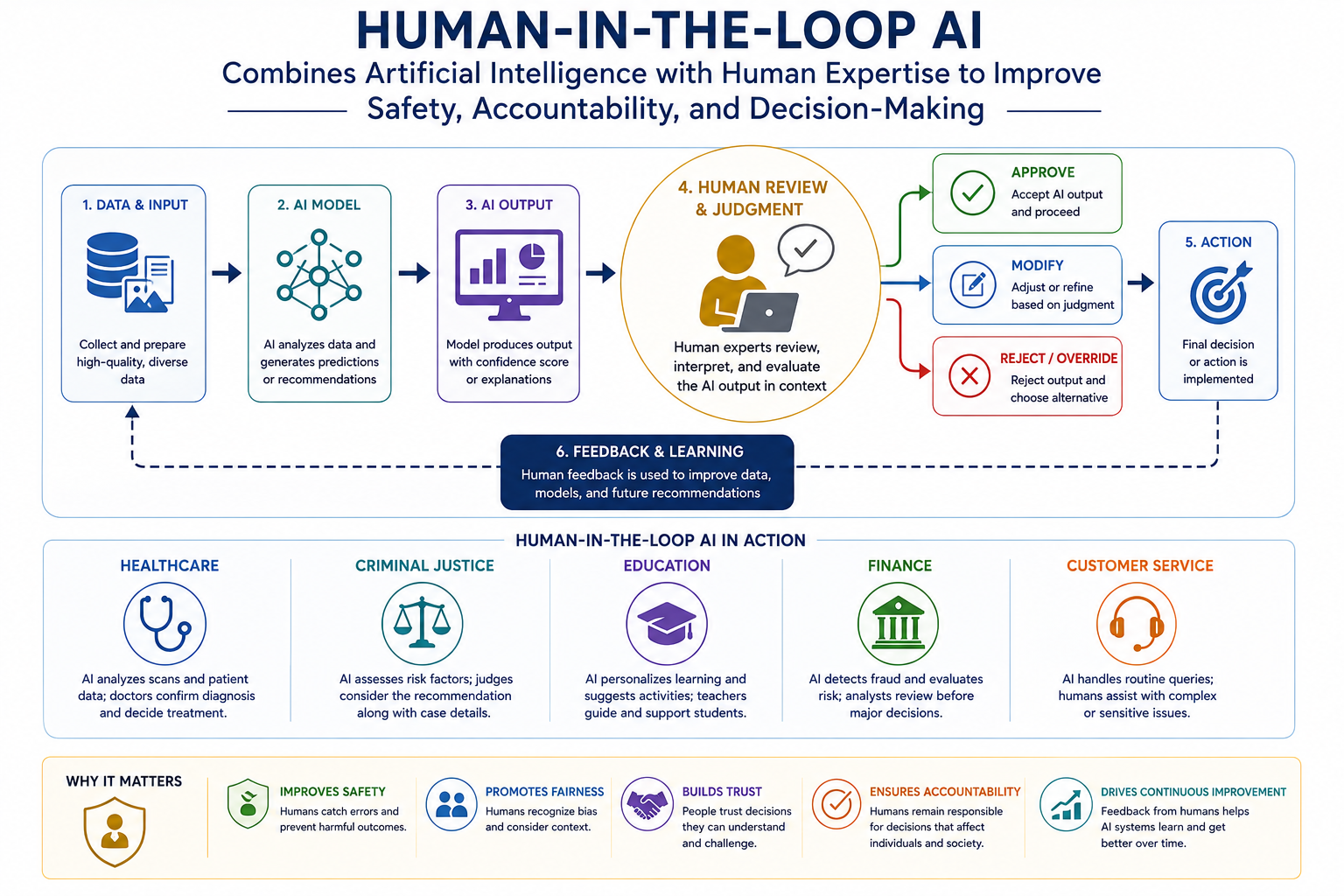
Instead, organizations increasingly adopt an approach known as Human-in-the-Loop (HITL) AI, where artificial intelligence supports human decision-making rather than replacing it. In this collaborative model, AI performs tasks such as analyzing data, identifying patterns, or generating recommendations, while humans review, interpret, and approve important decisions before action is taken.
Rather than viewing humans and AI as competitors, Human-in-the-Loop AI recognizes that each brings unique strengths. AI offers speed, consistency, and large-scale data analysis, while humans contribute judgment, ethical reasoning, contextual understanding, and accountability.
What Is Human-in-the-Loop AI?
Human-in-the-Loop AI refers to systems in which people actively participate during one or more stages of an AI system's lifecycle.
Rather than allowing AI to make completely autonomous decisions, humans remain involved by reviewing recommendations, correcting mistakes, validating outputs, or making the final decision.
The level of human involvement depends on the application.
For example, a spell-checking application may automatically correct simple typing errors with minimal human oversight. In contrast, an AI system assisting with cancer diagnosis should always support—not replace—the expertise of qualified medical professionals.
Human involvement may occur during:
- Data collection and labeling
- Model training
- Testing and evaluation
- Reviewing AI recommendations
- Monitoring deployed systems
- Correcting errors and updating models
Because AI continuously learns from data and feedback, human expertise remains valuable throughout the system's entire lifecycle.
Why Human Judgment Is Still Essential
Although AI excels at identifying statistical patterns, it does not possess human understanding. AI cannot truly comprehend emotions, social values, cultural expectations, or ethical responsibilities in the way humans do.
For example, two patients with similar medical records may require different treatment decisions because of personal circumstances, family preferences, or lifestyle considerations—factors that may not be fully represented within the data.
Similarly, a recruitment algorithm may rank candidates based on historical hiring patterns, but an experienced hiring manager can recognize unique strengths that fall outside those patterns.
Humans also understand context. An AI recommendation that appears reasonable mathematically may be inappropriate when broader circumstances are considered.
Finally, humans remain accountable. When significant decisions affect people's health, finances, education, employment, or legal rights, organizations are expected to explain and justify those decisions. Accountability ultimately rests with people—not algorithms.
Human-in-the-Loop in Practice
Healthcare
AI systems increasingly assist physicians by analyzing medical images, identifying potential diseases, and estimating patient risks.
However, physicians review these recommendations alongside laboratory results, patient histories, and clinical examinations before making treatment decisions. AI provides decision support; doctors provide medical judgment.
Criminal Justice
Risk assessment systems may estimate the likelihood of reoffending. Judges can consider these assessments as one source of information while also evaluating evidence, legal principles, and individual circumstances.
Human oversight helps prevent AI recommendations from becoming automatic legal decisions.
Education
AI tutoring systems personalize learning materials and recommend activities based on student performance.
Teachers interpret these recommendations while considering classroom observations, student motivation, social development, and individual learning needs. This partnership allows technology to enhance rather than replace teaching.
Finance
Banks increasingly use AI to identify fraudulent transactions and evaluate financial risk. Suspicious cases are often reviewed by human analysts before accounts are frozen or major financial actions are taken.
Human review reduces unnecessary disruptions caused by false alarms.
Customer Service
AI chatbots answer routine questions quickly and efficiently. When conversations become emotionally sensitive or unusually complex, customers are transferred to human representatives who can exercise empathy, flexibility, and problem-solving skills beyond the AI's capabilities.
Benefits of Human-in-the-Loop AI
Keeping humans involved offers several important advantages.
First, it improves accuracy by allowing experts to identify AI errors before decisions are implemented.
Second, it strengthens fairness by enabling reviewers to recognize potential biases that automated systems may overlook.
Third, it increases trust because users are more confident when important decisions include meaningful human oversight.
Human involvement also improves AI systems themselves. Corrections made by experts can be incorporated into future training data, allowing models to gradually improve over time.
Finally, Human-in-the-Loop AI supports accountability by ensuring that organizations remain responsible for decisions affecting individuals rather than attributing responsibility solely to technology.
Challenges of Human-in-the-Loop Systems
Although Human-in-the-Loop AI offers significant benefits, implementing it effectively presents challenges.
Human review requires additional time, expertise, and resources.
Organizations must determine which decisions require human oversight and which routine tasks can safely remain automated.
Another challenge is automation bias.
People sometimes trust AI recommendations too readily, assuming that computers are always correct.
Conversely, some individuals may reject AI recommendations without carefully evaluating their evidence.
Effective Human-in-the-Loop systems encourage balanced collaboration rather than unquestioning acceptance or complete distrust.
Organizations must also ensure that reviewers receive appropriate training so they understand both the capabilities and limitations of AI systems.
The Future of Human-AI Collaboration
As AI technologies continue to evolve, completely autonomous decision-making will likely remain appropriate for only a limited range of low-risk tasks.
For high-stakes applications, the future is increasingly focused on collaboration rather than replacement.
Researchers are developing AI systems that provide clearer explanations, communicate uncertainty more effectively, and actively request human assistance when confidence is low.
Rather than asking whether humans or AI perform better independently, organizations are increasingly asking:
How can humans and AI work together to make better decisions than either could make alone?
This collaborative approach represents one of the central goals of Responsible AI.
Conclusion
Artificial Intelligence has become an extraordinary tool for analyzing information and supporting complex decisions. Yet even the most advanced AI systems remain limited by their training data, design choices, and inability to fully understand human values and context.
Human-in-the-Loop AI recognizes that responsible decision-making is strongest when artificial intelligence and human expertise work together.
By combining AI's speed and analytical power with human judgment, ethical reasoning, and accountability, organizations can build systems that are not only more accurate but also more trustworthy, transparent, and responsible.
In the next article, we will bring together the principles explored throughout this category by examining Responsible AI Governance, where fairness, transparency, accountability, and human oversight are integrated into organizational AI practices.
Key Takeaways
- Human-in-the-Loop AI combines artificial intelligence with human expertise throughout the AI lifecycle.
- AI provides speed, consistency, and pattern recognition, while humans contribute judgment, ethics, context, and accountability.
- Human oversight is particularly important in healthcare, education, finance, recruitment, and criminal justice.
- Human feedback helps improve AI systems by correcting errors and refining future model performance.
- Effective Human-in-the-Loop systems balance automation with meaningful human review rather than relying exclusively on either.
- Responsible AI emphasizes collaboration between humans and AI instead of viewing one as a replacement for the other.
- Human judgment remains essential whenever AI decisions have significant consequences for individuals or society.