

The Science of AI
Beginner
8 min read
Model Distillation
Discover how model distillation transfers knowledge from powerful AI systems into smaller, faster, and more efficient models, making advanced intelligence practical for real-world applications.
Introduction
Over the past decade, Artificial Intelligence has advanced rapidly through the development of increasingly larger models. Today's frontier language models contain billions—or even trillions—of parameters and require enormous computational resources for training and deployment. While these systems demonstrate remarkable capabilities, they are also expensive to operate, consume significant amounts of energy, and often require specialized hardware.
This raises an important question.
If a large AI model has already learned useful knowledge, is it necessary for every application to use the full-sized model?
Researchers discovered that the answer is often no.
Instead of deploying enormous models everywhere, it is frequently possible to train a much smaller model that learns from the behavior of the larger one. This process is known as model distillation. Rather than copying every parameter, the smaller model learns to imitate the larger model's predictions, allowing it to capture much of the original intelligence while using only a fraction of the computational resources.
Today, model distillation has become one of the most influential techniques for making Artificial Intelligence practical, efficient, and accessible.
Why Large Models Are Not Always Practical
Large foundation models have transformed Artificial Intelligence because they can solve an extraordinary range of problems using a single architecture. However, their size also introduces important practical limitations.
Running a frontier language model requires considerable computing power, large amounts of memory, and significant electrical energy. These requirements may be acceptable for cloud-based services operating in large data centers, but they become far more challenging for smartphones, laptops, autonomous robots, medical devices, satellites, or industrial equipment operating with limited hardware.
Latency also becomes an important consideration. Users generally expect AI systems to respond almost instantly. Smaller models often produce answers much more quickly, making them attractive for interactive applications.
These practical constraints motivated researchers to ask whether much of the intelligence developed by very large models could be transferred into smaller and more efficient systems.
What Is Model Distillation?
Model distillation is often described using the analogy of a teacher and a student.Imagine an experienced university professor teaching a difficult subject to a class. Rather than requiring every student to rediscover the knowledge independently, the professor explains concepts, corrects misunderstandings, and demonstrates effective problem-solving strategies.
Eventually, the students develop much of the professor's understanding without repeating every step of the original learning journey.
Model distillation follows a remarkably similar process.
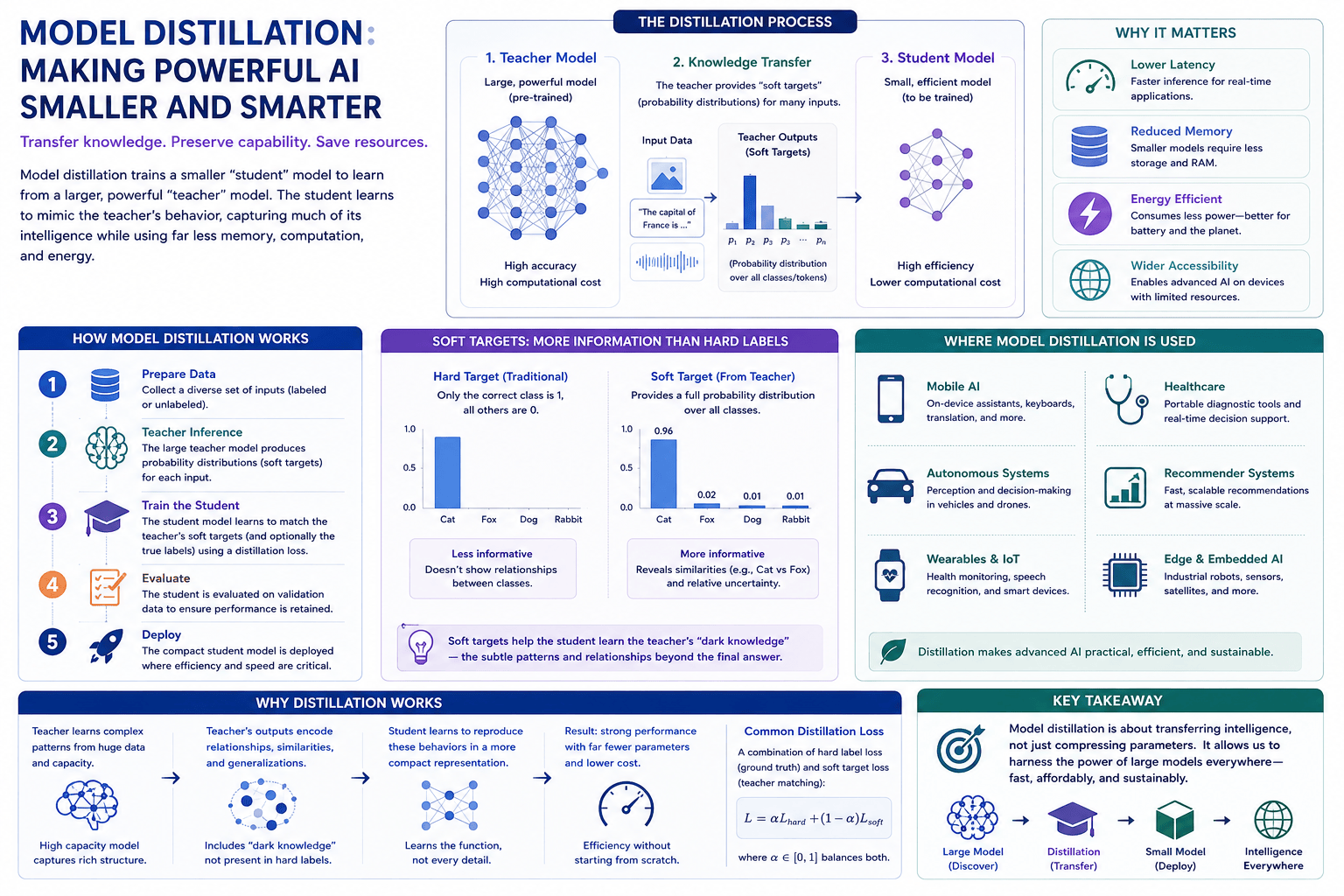
A large, highly capable neural network, called the teacher model, first learns from enormous amounts of training data. A second, much smaller student model is then trained to imitate the teacher's outputs rather than learning only from the original data.
Because the teacher already captures complex relationships within the data, the student can often learn these patterns much more efficiently than if it were trained entirely from scratch.
Learning From Soft Targets
One of the most elegant ideas behind model distillation is that the teacher provides more than simply the correct answer.Traditional supervised learning often trains models using hard targets, where each training example has a single correct label.
For example, an image might simply be labeled "cat."
The teacher model, however, produces a probability distribution across many possible classes.
Instead of predicting:
"Cat = 1, everything else = 0"
the teacher might predict:
- Cat: 96%
- Fox: 2%
- Dog: 1%
- Rabbit: 1%
Although the teacher correctly identifies the image as a cat, it also reveals that foxes and dogs share certain visual similarities while rabbits are much less likely.
The student therefore learns not only the correct answer but also the teacher's deeper understanding of relationships between different concepts.
This additional information often enables the student model to generalize remarkably well despite having far fewer parameters.
Why Distillation Works So Well
At first glance, it may seem surprising that a much smaller model can approach the performance of a significantly larger one.The explanation lies in the way knowledge is transferred.
The large teacher model has already learned an extremely sophisticated representation of the underlying data. During distillation, the student does not need to rediscover these representations independently. Instead, it learns to reproduce the teacher's behavior across a wide variety of inputs.
In many applications, this transfer captures the most important aspects of the teacher's knowledge while discarding some of the computational complexity required to produce it.
Although the student rarely matches every capability of the teacher, the resulting trade-off between efficiency and performance is often remarkably favorable.
Where Model Distillation Is Used
Model distillation has become an essential technique across modern Artificial Intelligence because it enables advanced models to be deployed in situations where computational resources are limited.Some important applications include:
- Mobile AI assistants running directly on smartphones.
- Speech recognition systems operating on wearable devices.
- Computer vision models embedded in autonomous vehicles and drones.
- Medical AI tools used in portable diagnostic equipment.
- Recommendation systems requiring millions of rapid predictions each second.
- Large Language Models optimized for faster local inference and lower energy consumption.
Distillation and the Future of AI
As AI continues to evolve, many researchers believe that future progress will involve not only building larger models but also improving the efficiency with which intelligence is represented.Model distillation forms part of a broader movement toward efficient AI, alongside techniques such as model pruning, quantization, sparse architectures, retrieval-augmented systems, and specialized hardware accelerators.
These complementary approaches all pursue the same fundamental objective: maximizing useful intelligence while minimizing computational cost.
This shift represents an important change in modern AI research. Rather than measuring success solely by parameter count, researchers increasingly evaluate models according to multiple criteria, including accuracy, efficiency, latency, energy consumption, robustness, and accessibility.
The future of Artificial Intelligence will therefore depend not only on creating more capable systems, but also on ensuring those capabilities can be delivered efficiently to billions of people around the world.
Conclusion
Model distillation demonstrates that progress in Artificial Intelligence is not driven solely by creating larger models. Equally important is learning how to preserve intelligence while dramatically improving efficiency.By allowing smaller models to learn from the knowledge already acquired by larger ones, distillation has made modern AI faster, more affordable, more sustainable, and easier to deploy across a wide variety of real-world applications.
As researchers continue developing increasingly capable AI systems, techniques such as distillation will play a central role in ensuring that advanced intelligence is not confined to powerful data centers but becomes widely available across everyday devices and industries.
Key Takeaways
- Model distillation transfers knowledge from a large teacher model to a smaller student model.
- The student learns by imitating the teacher's predictions rather than relying solely on the original training labels.
- Soft targets provide richer information than traditional hard labels, helping smaller models learn more effectively.
- Distilled models often achieve an excellent balance between performance, speed, memory usage, and energy efficiency.
- Model distillation enables AI deployment on smartphones, embedded systems, medical devices, autonomous vehicles, and other resource-constrained environments.
- Efficient AI is increasingly important for sustainability, accessibility, and large-scale deployment.
- Model distillation illustrates that the future of AI depends not only on building larger models but also on making intelligence more efficient and widely available.