

Future of AI
Beginner
8 min read
Can Laws Keep Up?
Discover why effective AI regulation is essential for balancing innovation, safety, accountability, and public trust as artificial intelligence becomes part of everyday life.
Introduction
Artificial Intelligence is evolving at an extraordinary pace. New AI models, intelligent assistants, and autonomous systems are being introduced faster than many organizations and governments can fully understand or regulate them. As AI becomes increasingly integrated into healthcare, education, finance, transportation, manufacturing, scientific research, and public services, questions about safety, accountability, fairness, and privacy have become more important than ever.Technological innovation has often advanced more quickly than legislation. The internet, social media, cryptocurrencies, and biotechnology all demonstrated that governments frequently face the challenge of regulating rapidly changing technologies while still encouraging innovation. Artificial Intelligence presents a similar challenge—but on an even larger scale because of its potential to influence almost every sector of society.
Rather than asking whether AI should be regulated, today's discussion increasingly focuses on how regulation can protect people while still allowing innovation to flourish.
Why AI Regulation Matters
Artificial Intelligence is capable of making recommendations, generating content, supporting medical diagnoses, assisting financial decisions, and automating complex workflows. As these systems become more capable, their influence on individuals and society also increases.Without appropriate safeguards, AI systems may unintentionally produce biased outcomes, generate misinformation, expose sensitive information, or make decisions that affect people's lives without sufficient transparency or accountability. These risks do not mean AI should be avoided; rather, they highlight the importance of responsible oversight.
As discussed in Responsible AI Governance, organizations already have a responsibility to develop AI systems ethically. Regulation extends this idea beyond individual organizations by establishing broader legal frameworks that protect citizens, encourage responsible innovation, and create common expectations across industries.
Good regulation therefore builds public confidence, making it more likely that people will trust and adopt AI technologies that genuinely improve their lives.
Different Countries Are Taking Different Approaches
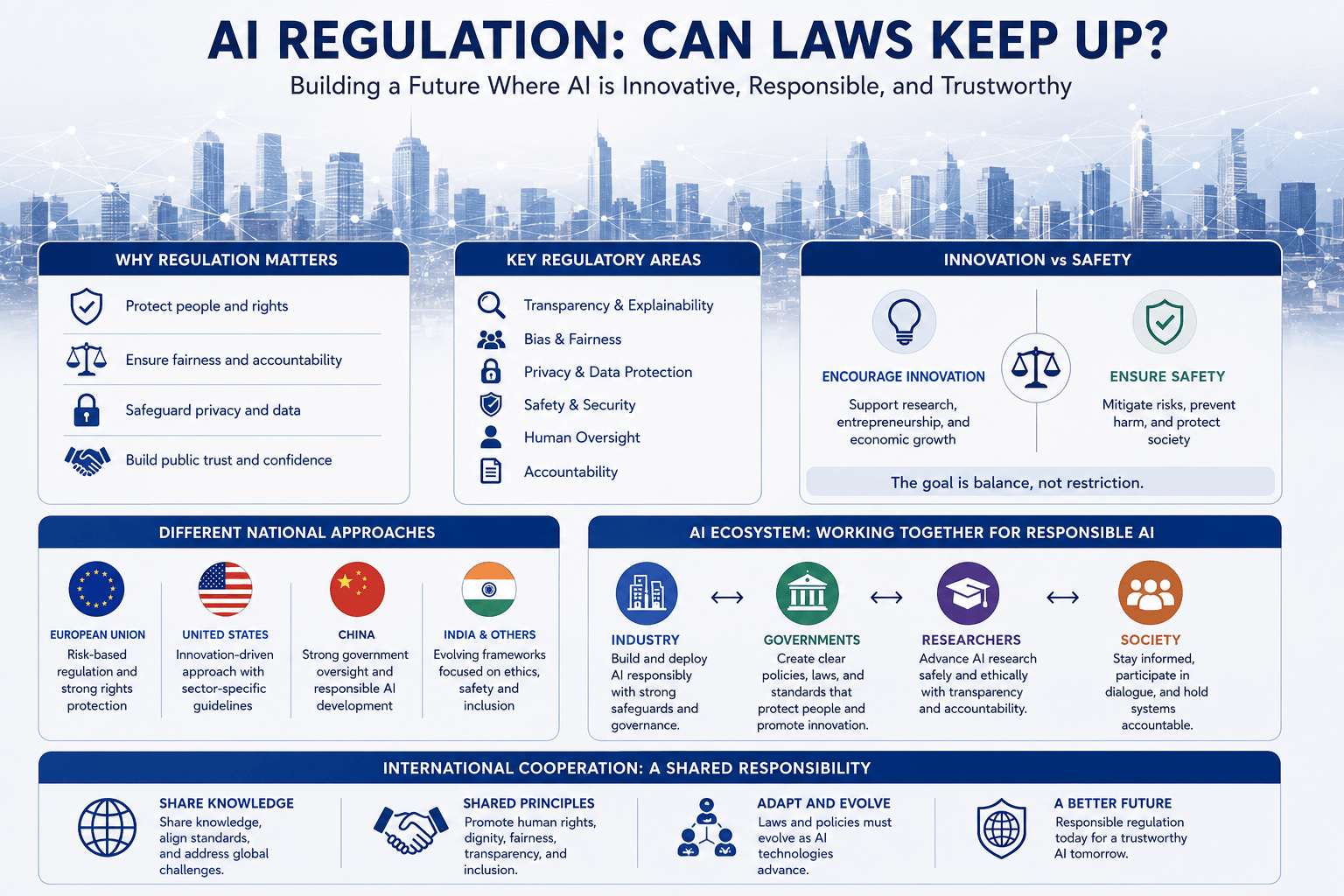
One of the challenges of regulating AI is that no single country controls its development. AI research, software development, cloud computing, and digital services operate across international borders, making global coordination both necessary and difficult.Different governments have adopted different strategies based on their legal systems, economic priorities, and societal values. Some emphasize innovation and economic competitiveness, while others place greater emphasis on privacy, consumer protection, transparency, or human rights.
Although specific policies continue to evolve, many regulatory discussions focus on similar objectives:
- Promoting trustworthy AI
- Protecting privacy and personal data
- Reducing harmful bias and discrimination
- Improving transparency and accountability
- Managing high-risk AI applications
- Encouraging responsible innovation
- Supporting international cooperation
Balancing Innovation and Safety
One of the most important questions in AI policy is how to encourage innovation without compromising public safety.If regulations become excessively restrictive, they may slow scientific research, reduce investment, and discourage entrepreneurs from developing beneficial AI applications. On the other hand, insufficient regulation may allow unsafe or unreliable systems to be deployed before appropriate safeguards are in place.
Most experts therefore advocate a balanced approach.
Rather than regulating every AI application equally, many proposed frameworks focus more closely on systems that present greater potential risks, such as AI used in healthcare, transportation, finance, employment, education, and criminal justice.
This risk-based approach allows lower-risk applications to continue developing while ensuring that higher-risk systems undergo greater testing, documentation, and oversight before deployment.
Open-Source AI and Foundation Models
Another important area of discussion concerns foundation models and open-source AI.Foundation models are large, general-purpose AI systems that can be adapted for many different applications. Because these models serve as the foundation for countless downstream products, decisions made during their development can influence a wide range of industries.
At the same time, many developers support open-source AI, allowing researchers, businesses, and individuals to study, improve, and build upon existing models. Open-source development encourages transparency, collaboration, and innovation, but it also raises important questions about how increasingly powerful AI systems should be shared responsibly.
Regulators therefore face the challenge of encouraging open scientific collaboration while reducing opportunities for misuse. Striking this balance remains one of the most active areas of international AI policy.
The Need for International Cooperation
Artificial Intelligence does not recognize national borders. An AI application developed in one country may be used by millions of people around the world within days of its release. As a result, many AI challenges—including cybersecurity, misinformation, intellectual property, privacy, and safety—cannot be addressed by any one nation acting alone.International organizations, governments, universities, research institutions, and technology companies increasingly collaborate to develop shared principles, technical standards, and best practices for responsible AI development.
Although complete global agreement may be difficult to achieve, cooperation can help reduce duplication, encourage interoperability, promote scientific collaboration, and establish common expectations for trustworthy AI.
As AI continues to evolve, international dialogue is likely to become just as important as technological innovation itself.
Challenges That Lie Ahead
Artificial Intelligence is likely to continue advancing more rapidly than legal systems can adapt. New capabilities such as increasingly autonomous AI agents, highly personalized AI assistants, and more powerful foundation models will introduce opportunities that are difficult to anticipate using today's regulatory frameworks.This means AI regulation cannot remain static. Laws, technical standards, professional guidelines, and organizational policies will need to evolve alongside the technology itself.
Perhaps the greatest challenge is finding a balance that protects society without limiting the scientific discoveries and economic opportunities that AI can create. Achieving that balance will require continuous learning, evidence-based policymaking, international collaboration, and constructive dialogue among all stakeholders.
Conclusion
Artificial Intelligence presents one of the most significant regulatory challenges of the modern era. As AI systems become increasingly capable and integrated into everyday life, governments, businesses, researchers, and society must work together to ensure these technologies remain safe, trustworthy, and beneficial.Rather than viewing regulation as an obstacle to innovation, many experts see it as an essential foundation for long-term progress. Clear rules, responsible governance, and international cooperation can help build public confidence while allowing AI to continue improving healthcare, education, scientific research, business, and countless other fields.
The future of AI will therefore depend not only on technological breakthroughs but also on society's ability to develop thoughtful policies that encourage innovation while protecting fundamental human values.
In the final article of this series, Living with AI: Skills for the Next Decade, we will shift from governments and institutions to individuals, exploring the knowledge, skills, and mindset that will help people thrive in an AI-enabled world.
Key Takeaways
- AI regulation seeks to balance technological innovation with safety, accountability, privacy, and public trust.
- As AI becomes more capable, legal and ethical frameworks become increasingly important.
- Different countries are adopting different regulatory approaches based on their priorities and legal systems.
- Many proposed frameworks focus on risk-based regulation, giving greater oversight to higher-risk AI applications.
- Foundation models and open-source AI present both significant opportunities and new regulatory challenges.
- International cooperation is becoming essential because AI technologies operate across national borders.
- The future of AI depends not only on technological progress but also on effective governance, collaboration, and responsible policymaking.