

Prompt Engineering
Intermediate
10 min read
Prompt Refinement
Discover how iterative prompt improvement transforms good AI responses into exceptional ones.
Introduction
Even experienced AI users rarely write the perfect prompt on their first attempt.
Just as software developers revise code, researchers refine hypotheses, and authors edit multiple drafts before publication, effective prompt engineering is an iterative process. The first prompt provides a starting point, but the best results often emerge only after carefully evaluating the AI's response and making targeted improvements.
This process is known as Prompt Refinement.
Prompt Refinement is the practice of systematically improving prompts based on the quality of previous AI responses. Rather than repeatedly asking the same question, users analyze what worked, identify what could be improved, and modify the prompt accordingly.
For example, an initial prompt may produce a response that is too short, too technical, poorly organized, or missing important information. Instead of accepting the result or starting over completely, the user refines the prompt by adding context, clarifying objectives, assigning a role, providing examples, or requesting a different format.
Prompt Refinement brings together every technique explored in this category. The CLEAR Framework provides the structure, Role Prompting establishes perspective, Few-shot Prompting demonstrates the desired pattern, and Chain of Thought Prompting encourages systematic reasoning. Prompt Refinement combines these techniques into a continuous improvement process.
As AI systems become more capable, prompt refinement is increasingly viewed as an important professional skill, enabling users to collaborate more effectively with intelligent systems rather than treating them as simple question-answering tools.
The Prompt Refinement Cycle
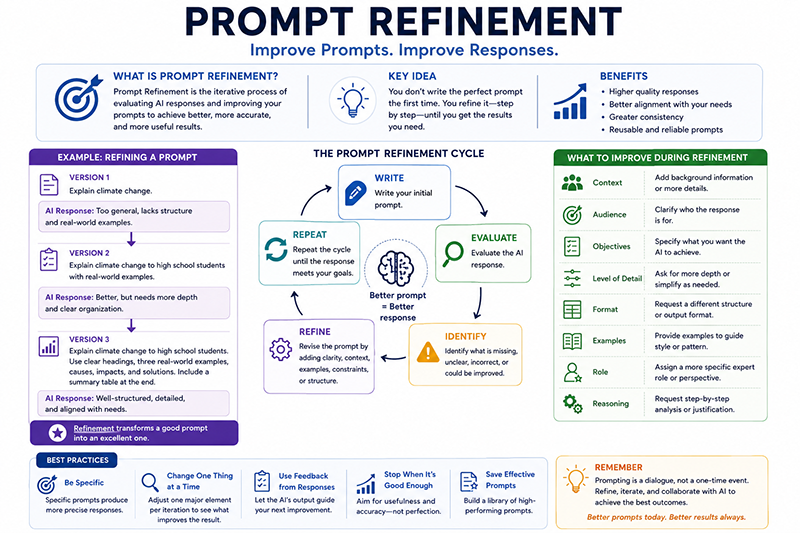
Prompt Refinement follows a simple but powerful cycle.
- Write the initial prompt.
- Evaluate the AI's response.
- Identify weaknesses or missing information.
- Revise the prompt.
- Repeat until the desired outcome is achieved.
Each iteration provides feedback that helps improve the next version.
Simple Example
The response may be accurate but overly general.
Now the explanation becomes more accessible.
The response is now much closer to the intended educational objective.
Each refinement builds upon the previous version.
Importantly, prompt refinement should be purposeful rather than random. Every revision should address a specific weakness identified in the previous response.
Experienced prompt engineers commonly refine prompts by adjusting:
- Context
- Audience
- Constraints
- Response format
- Level of detail
- Professional role
- Examples
- Reasoning requirements
These improvements often produce much larger gains than repeatedly rephrasing the same question.
Examples from Different Professions
Example 1 — Business Consultant
Why It Is Better: The refined prompt provides business context, defines the audience, specifies the required analytical framework, and requests an executive-level report rather than a generic strategy.
Example 2 — Teacher
Why It Is Better: The refined prompt clearly defines the curriculum, student level, question types, educational objective, and expected output format.
Example 3 — Software Developer
Why It Is Better: Rather than requesting generic code, the refined prompt specifies the programming language, functionality, documentation requirements, coding standards, and visualization library.
Example 4 — Human Resources Manager
Why It Is Better: The refined version defines the organization, role, audience, document structure, and professional expectations, producing a much more complete and usable result.
Example 5 — Research Scientist
Why It Is Better: The refined prompt transforms a simple summary into a structured academic review that supports deeper understanding and critical analysis.
Usefulness
Prompt Refinement is valuable because it recognizes that high-quality AI interactions rarely emerge from a single prompt.
Instead, users progressively improve communication with the AI by identifying weaknesses and making targeted revisions. This iterative approach leads to responses that are more accurate, better organized, and more closely aligned with the user's objectives.
Prompt Refinement is especially useful for complex professional tasks where precision matters. Researchers refine prompts to obtain better literature reviews. Educators refine prompts to create age-appropriate learning materials. Software developers refine prompts to improve generated code. Business professionals refine prompts to produce more actionable reports.
Another important benefit is efficiency. Rather than repeatedly rewriting prompts from scratch, users build upon previous versions, gradually creating prompt templates that can be reused for future projects.
Prompt Refinement also encourages critical thinking. Instead of accepting AI responses uncritically, users learn to evaluate quality, identify gaps, and improve both the prompt and the resulting output.
Ultimately, Prompt Refinement transforms prompting from a single interaction into a collaborative dialogue between the user and the AI.
Limitations
Although Prompt Refinement significantly improves prompt quality, it also has practical limitations.
First, refinement requires time. Simple tasks may not justify multiple iterations, particularly when a satisfactory answer is obtained immediately.
Second, refinement cannot overcome fundamental limitations of the AI model. If the underlying information is incorrect or unavailable, improving the prompt alone cannot guarantee an accurate response.
Third, excessive refinement may produce prompts that are unnecessarily complex. Very long prompts can sometimes reduce flexibility or introduce conflicting instructions that confuse the model.
Finally, users should avoid assuming that every improvement results from prompt changes alone. Different AI models, updated model versions, and external tools may also influence response quality.
Conclusion
Prompt Refinement represents the culmination of effective prompt engineering. Rather than treating prompting as a one-time activity, it encourages continuous improvement through evaluation, revision, and experimentation. This iterative mindset allows users to develop prompts that consistently produce accurate, relevant, and well-structured responses across a wide variety of professional tasks.
Throughout this Prompt Engineering category, you have learned how each technique contributes to better AI interactions. The CLEAR Framework introduced a structured approach to writing prompts. Role Prompting demonstrated how assigning an expert perspective improves responses. Few-shot Prompting showed how carefully selected examples teach the AI desired patterns. Chain of Thought Prompting encouraged structured reasoning for complex problems. Finally, Prompt Refinement brought these techniques together into a continuous process of improvement.
Together, these methods illustrate an important principle: effective prompting is not about discovering secret commands or "magic prompts." It is about communicating clearly, thinking critically, and collaborating with AI in a systematic and purposeful way. As AI systems continue to evolve, these underlying principles will remain valuable regardless of the specific models or tools being used.
Key Takeaways
- Prompt Refinement is the process of improving prompts through iterative evaluation and revision.
- Effective refinement focuses on specific improvements rather than repeatedly rewriting prompts from scratch.
- Users can refine context, audience, constraints, examples, reasoning requirements, and response format to improve AI outputs.
- Prompt Refinement combines naturally with the CLEAR Framework, Role Prompting, Few-shot Prompting, and Chain of Thought Prompting.
- Iterative prompting encourages critical thinking and leads to more consistent, reusable prompt templates.
- Not every limitation can be solved through refinement; users must also recognize the capabilities and limitations of the underlying AI model.
- Prompt engineering is fundamentally a process of effective communication, and Prompt Refinement is the technique that transforms good prompts into excellent ones through continuous improvement.