

AI Basics
Beginner
9 min read
Deep Learning
See how deep learning uses multiple layers to learn complex patterns from images, speech, language, and data.
Introduction
In the previous article, Machine Learning, we learned that computers can discover patterns by learning from data rather than following only hand-written rules. Traditional Machine Learning has achieved remarkable success in areas such as fraud detection, recommendation systems, and spam filtering. However, some problems are far more complex.
Recognizing faces in millions of photographs, understanding spoken language, translating between languages, or generating human-like text requires a more powerful approach. This is where Deep Learning comes in.
Deep Learning is a specialized branch of Machine Learning that enables computers to learn highly complex patterns from large amounts of data. It has become one of the driving forces behind today's AI revolution, powering technologies such as facial recognition, self-driving cars, virtual assistants, medical image analysis, and generative AI systems.
What is AI? introduced Artificial Intelligence as the broader field, while Machine Learning explained how computers learn from data. Deep Learning builds directly upon these ideas by allowing machines to understand information in much greater depth.
Learning Through Layers
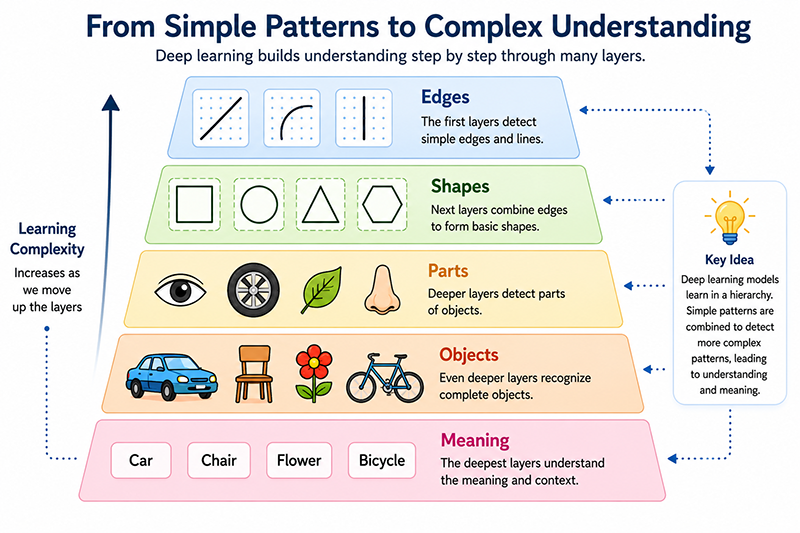
The word "deep" refers to the many layers used within a Deep Learning model. These layers allow the computer to learn information gradually, beginning with simple patterns and combining them into increasingly complex concepts.
Consider how a computer might recognize a photograph of a dog. The first layer may simply detect edges and lines. The next layer combines those edges into simple shapes. Later layers identify features such as eyes, ears, legs, or fur. Eventually, the deepest layers combine all these features to recognize that the image contains a dog.
This layered learning process allows Deep Learning models to automatically discover important features without requiring programmers to manually define them.
Unlike many traditional Machine Learning methods, where experts often decide which features are important, Deep Learning learns these features directly from the data itself. This ability makes it particularly effective for working with images, speech, natural language, and video.
The process of training a Deep Learning model is similar to the Machine Learning process you learned previously. The model receives data, makes predictions, compares those predictions with the correct answers, measures its errors, and then adjusts itself to improve. This cycle repeats thousands, or sometimes millions, of times until the model becomes increasingly accurate.
Why Deep Learning Matters
Deep Learning has transformed Artificial Intelligence because it can solve problems that were once considered extremely difficult for computers.
Image recognition systems can now identify thousands of different objects with remarkable accuracy. Voice assistants can understand spoken commands even when people have different accents. Translation systems can convert text between dozens of languages almost instantly. Medical researchers use Deep Learning to help identify diseases from X-rays and MRI scans. Self-driving vehicles analyze roads, traffic signs, pedestrians, and surrounding vehicles in real time.
Perhaps most importantly, Deep Learning has made Generative AI possible. Modern systems that generate text, images, music, videos, and computer code all rely heavily on Deep Learning techniques.
These impressive achievements come at a cost. Deep Learning models usually require large amounts of data, powerful computing hardware, and well-designed model architectures. Without enough data or computing power, Deep Learning models often struggle to achieve good performance.
Deep Learning models may also inherit bias from their training data. If the data contains incomplete or biased information, the model may produce biased or unfair predictions. This reinforces an important idea introduced in What is AI?: AI systems are only as reliable as the data used to build them.
So what actually makes Deep Learning possible? The answer lies in Neural Networks, interconnected computational structures inspired by the organization of neurons in the human brain.
Conclusion
Deep Learning represents one of the most significant advances in modern Artificial Intelligence. By learning through multiple layers, Deep Learning systems can automatically recognize complex patterns that would be extremely difficult to program manually.
Building upon the concepts introduced in Machine Learning, Deep Learning has enabled breakthroughs in computer vision, speech recognition, language translation, medical diagnosis, robotics, and generative AI.
In the next article, you will look inside these systems and explore Neural Networks, the computational structures that make Deep Learning possible.
Key Takeaways
- Deep Learning is a specialized branch of Machine Learning that learns complex patterns using many layers.
- The word "deep" refers to the multiple layers that gradually build understanding from simple patterns to complex concepts.
- Deep Learning excels at tasks involving images, speech, language, video, and generative AI.
- Deep Learning models learn by repeatedly making predictions, measuring errors, and adjusting themselves.
- These models require large datasets, significant computing power, and carefully designed architectures.
- Deep Learning models are built using Neural Networks, which you will explore in the next article.